Thursday, December 23, 2021

Erasure Experiments

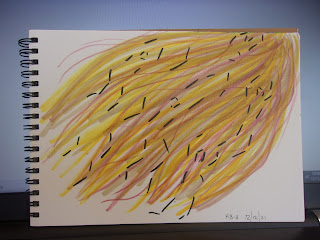
Yesterday, I experimented with an erasure poem:


Last week, I saw this erasure poem here by Sarah J. Sloat (source text from a twitter exchange with her:  "this is a page from William Golding's novel 'Pincher Martin,' about a shipwreck":


I loved the simplicity of it.  I love her poems that combine erasure and collage, but my collaging skills often leave me frustrated:  finding the right image, cutting it correctly, gluing so that the image stays stuck to the page, but the page stays flat. 

Yesterday, after spending too much time staring at screens at work, I remembered this erasure poem, and reached for my bookshelves at work.  I decided to work with Bill McKibben's The Age of Missing Information.  I flipped to a random page, and I printed it on the copy machine and then enlarged it. I made a few extra copies, since I may keep playing with a text if the first approach goes well. 


So far, when I do an erasure poem, I look for the words first and then figure out what to do next.  Here are the words I saved.  Let me write them here and see if they work as a poem:

piece of land

groundwater's shadow

growing

logic to the layout

tiny pond

tell their inhabitants

As I looked at the words, I decided to use blue and green markers to strike through the rest of the text.  Here's how it looked at the end of the session:


I may decide to do more with it, or I may decide to do a different draft with a clean copy or I may decide to move along to something else.

After my session of drawing horizontal lines in blue and green, I felt refreshed--hurrah for creativity.  I did this at the end of the day, when my poetry brain wouldn't have been able to create something if I just stared at a blank page.  It was good to have something creative to do, even when I couldn't create something brand new out of nothing.


Wednesday, December 22, 2021

Snippets from a Very Strange Pre-Christmas Season

My seminary writing is over, my grades are turned in, so why do I feel like I can't compose a coherent blog post?  Let me record some snippets from this very strange pre-Christmas season that I don't want to lose:

--My hips, wrists and fingers are sore today in weird ways.  I was on my feet a lot of yesterday, putting baseball caps into cellophane bags and twisting them with a twist tie that was half an inch too short, but usable if I squeezed hard enough.  It's a winter student appreciation event.  I am not a baseball cap person myself, but many students seemed touched.

--I sent this Facebook message to a colleague and friend, which seems to perfectly capture what I'm feeling these days:  "Up early enough to make chocolate cake for Mollie's b'day--budget your calories accordingly. Or, what the heck, we're going into year 3 of a global pandemic, so maybe we're not paying attention to calories anymore."

--I have yet to bake Christmas cookies or bread, so it seems strange to make a chocolate cake.  But I have milk that I need to use up, and cake seems more fitting for a birthday at work, and baking a cake from scratch is much easier than cookies or bread.

--Our condo building put a pool table and other games into the major sitting room downstairs, and my spouse and I have been playing the occasional game of pool and/or PacMan.  It's a fun thing to do for free that we wouldn't be able to do in other living situations.

--I've been enjoying seeing neighborhood lights as I walk each morning.  I feel like I should send everyone a thank you note.  It keeps me motivated to keep walking each morning, even though it's been unseasonably warm and humid.  The weather, too, is a disconnect from the season.  It always is.

--I made this tweet/Facebook post yesterday:  "Because life is not unsettled enough, we are under a gale warning until 10 p.m. tonight. Granted, I do not have a boat, but I don't remember ever having a gale warning in late December in South Florida."  Happily, the weather just seemed a bit breezier than usual, with a spat of rain here and there.  It could have been much worse.

--We've taken a different approach to an Advent wreath this year, since lit candles on a wreath don't feel safe in our rental condo.  We have a balcony, and on 4 rails, we've wrapped blue lights.  Week 1, we plugged in one rail's strand, two weeks = 2 rails, and so on.  It's been lovely.

--My mom and dad called me at work, and my first words after "Hello" were, "Are you sick?"  In this time of a new variant and cases skyrocketing, that's my love language, my way of saying, "Please don't die on me just yet."

--Most holiday seasons leave me wistful for the time when I had more children in my life and make me wonder if I should have had children of my own.  This holiday season, I'm glad that there aren't many children.  We are having trouble being festive, and I'm glad not to have the pressure of making magic for the children.

--Yet throughout the days, for the past few weeks, I have had the Magnificat in my head, the words of Mary:  "Surely from now on, all generations will call me blessed" (Luke 1:  48b).

Tuesday, December 21, 2021

Taking Our Temperatures Again

I took my temperature for the first time since 2020. I wonder if future generations will understand the implications of that sentence.  Will they remember the original time of pandemic panic in March of 2020?  Will they remember the Omicron variant exploding across the globe at the end of 2021?  Will they wonder why we ever stopped taking our temperatures?

Yesterday afternoon, I was feeling warm with a throat that felt tight/scratchy, and at church on Sunday, I had also had a feverish feeling moment.  So yesterday, I reached for the thermometer that used to be part of our campus entrance table. My temp is normal, so I'm guessing the sweatiness is from December days with high temps above normal, in the high 80's.  Plus, our AC in the condo we're renting isn't working correctly. My scratchy throat is likely from remodeling dust or paint fumes, since I have it at work where the remodeling is happening and not this morning at home.

Yesterday the AC repair person came and found a pinhole leak; he'll return on Wednesday to fix it.  I wish I could say that I'm reveling in being a renter at this moment, but since I'm both a renter and a home owner, I'm not feeling the reveling just yet.  Hopefully we will close on the house before Jan. 5.

This past year, even more than 2020, has been so topsy-turvy, so full of pivots.  My campus will close when the lease runs out, but maybe, instead, programs will move to the campus, construction will happen, and the future will be unclear for different reasons.  The real estate market is red hot, probably hotter than it will ever be again, we've gotten more contracts on the house than we thought possible, but getting to the closing proves more difficult than we thought, because a red hot market driven by investors is very different than the real estate markets of our parents.  We move to a condo that looks like the height of luxury only to discover that the roof top pool is closed for repairs--and it still is.

Some elements of 2021 have proceeded as I envisioned, namely my seminary journey.  Let me also list a few more.  I decided that a 2 bedroom rental made sense, keeping a guest room in case we needed to quarantine in case a new variant proved to be able to work around vaccine defenses.  So far, our teaching lives haven't changed much in 2021--hard to predict what 2022 will bring.  While I wish I could say that we've finally conquered our cravings in the most positive ways, we can only do that in short bursts at a time.

When I think about the progress of the year, however, the whiplash returns.  In January of 2021, I had no idea this would be the year I would start seminary. I saw vaccines rolling out, and while I knew it wouldn't be a quick end to the pandemic, I am still stunned at the twists and turns; when I got our appointments for our first shots, I reacted like I had won a lottery prize, and in a way I had.  Back in January of 2021, I knew that my school had been sold, but I would not have expected all the twists and turns of varying enrollments and approaches to the building plans.  At church, we've done in person church and shifted back to distance church, then gathered in person again, and now I am wondering if it is wise to gather for Christmas Eve.  In January of 2021, we talked about home improvements, but not because we planned to sell the house; the housing market had yet to gather that kind of momentum that has left so many of us thinking that it is time to sell our houses in South Florida.

So here we are at the winter solstice, the time when we add a bit more light to either side of the day. In this year of whiplash, I like any shift that enters slowly and gives us time to get used to it.  The shifts of the past year may have taken a season or longer, but they have felt wrenching nonetheless.  I hope that January of 2022 brings me closure on some of these projects, a gentle closure, not the slamming/wrenching kind of closure.  

Monday, December 20, 2021

Bubonic Plague, Respiratory Diseases, and Time Travel

This past week-end, I read Doomsday Book by Connie Willis.  I had read it before, in October of 2014; one of the benefits of keeping a blog is that I have a record (to read my first impressions of the book, see this blog post).  During this rereading, I entered into the book much more quickly.  It's interesting to read this book in a time of pandemic resurgence.  The book takes place both in the future and the past, with new diseases sweeping through the population:  a new strain of flu in the future and the bubonic plague in the past.

I was much more interested in the future flu than I was the first time that I read.  I was surprised by how much Willis got correct about that.  During the first read, I just wanted details about the bubonic plague.  This time, I was interested in the correspondences--and in the science.

I've been thinking about the times when my teaching corresponded with outbreaks of plague--in the history and the literature, for the most part.  I remember teaching the first half of British literature and explaining how the bubonic plague made the Renaissance possible.   I remember asking my students, "Imagine that if half of the people in this class died suddenly, half the people in the U.S. died in a season.  What questions would that inspire?  How would it affect your belief in government, your belief in God?"

I taught those classes and those questions in the early 1990's.  I didn't imagine how I would see them play out in my life time.  I would not have been able to imagine the lack of faith that people have in their government right now, the lack of faith in government with perhaps a faith in God that allows people to refuse a proven vaccine.  I have occasionally wondered if my students remember those classes as vividly as I do.

I remember teaching Keats which always led me to talk about TB, about Keats' experience of coughing up a part of his lungs each morning, which would remind him that he didn't have all the time in the world to write, that he wasn't likely to make it to midlife, much less old age.  How did that impact him?  How would it impact any of us?

I remember talking about how hard it is to control the spread of a disease that's transmitted by coughing or even simply breathing.  I remember talking about how easy it is to contain a disease like AIDS, which requires such intimate contact, that mingling of fluids.

As I think back to my younger teacher self, I think about how much I knew--yes, indeed, it is hard to control a disease that spreads through the air.  I have often thought about AIDS and condoms and people refusing to wear masks--no wonder it was so hard to get people to wear condoms regularly.

I have spent most of my life expecting an apocalypse, but I didn't think it would be a new respiratory disease.  I've watched new bird flus come and go, and they've lost their power to terrify.  I've worried about diseases like Ebola or some sort of bubonic plague that might kill us quickly.  But a disease that's fairly contagious, more so than flu, and virulent for parts of the population but less virulent for others?  A virus where some of us barely know we have it while others die a horrible death?  That wasn't part of my apocalyptic expectations.

As I read the last part of the Willis book, the part where bubonic plague has taken hold, I recognized the exhaustion, the disbelief that any of this is happening, the return to exhaustion.  I have gone through this on a small scale with my mother-in-law in the last 4.5 months of her life.  I can't imagine going through it as a whole town dies before one's eyes, with no one left to ring the bells to get the souls to Heaven, as the medieval priest believes is necessary in the Willis book.

I don't think we're headed to that experience with this new variant, but I do think it's going to be a tough winter.  Happily, there will be books to get us through, and I had already decided to continue seminary from a distance.  Will there be an onground intensive face to face in January?  Time will tell. 

Sunday, December 19, 2021

Celebrating School Endings with Candy and Car Repairs

Yesterday I decided to take my car in to the shop.  I had been hearing a scraping kind of noise when I turned the steering wheel in a hard left.  I confess that my first inclination was to avoid making hard lefts, but I also have some travel by car coming in the next few weeks, so to the shop I went yesterday morning.  Happily I was able to leave it and walk back home.

Sure enough, my car has issues, including lots of rust.  In a way, I'm not surprised.  It's a rare week that I don't drive through flooded streets down here.  And the car is 7 years old.

You're going to ask me what I had replaced, and I'm not sure.  It's not the tie rod, but it is something that's part of the system that keeps the wheels attached to the car.  And for good measure, some shock absorbers for the back tires.  My spouse listened to the call with the mechanic, so I don't feel like the mechanic was taking advantage of my lack of knowledge.

It's a huge bill, and my first thought was absolutely no way am I putting that kind of money into an old car.  My spouse was the voice of reason; he said, "If you want to keep it, we need to make the repair."  And knowing what we know about car shortages across the land, a huge repair bill is still cheaper than replacing the car, even if we could find one to buy.

It's not how I planned to celebrate having grades for my online classes turned in and papers for my seminary classes done.  Happily, we did that on Friday night.  We went to the brewery at Hollywood Beach, and we went early, before the crowds.  I like the brewery for many reasons, but during this time of surging pandemic, I like it because it's outdoor dining, but it's raised above the crowds.  The people walking by on the Hollywood Beach Broadwalk are below our feet, so it feels a bit safer in terms of disease transmission.

Despite an unexpected car bill that's unexpectedly high, I feel fortunate.  We have money set aside for just this possibility.  I know so many people who are dealing with such a variety of health issues (none of them COVID caused), so I know how much worse it could be.  I am often reminded of words of wisdom in one of Anne Lamotte's early books, when one of her friends said that a problem solved by an infusion of cash is not really an interesting problem.  It's especially not a problem when one has the money.

Even with car issues and just this morning, AC issues, it's been a delightful week-end.  I've been reading Connie Willis' Doomsday Book, a book about bubonic plague and flu and time travel and Advent and theology; I've read it before, and I'm even more impressed this time.  We watched some Christmas cooking shows while sorting through paperwork.  I had a lovely conversation with my mom and dad on the phone.  We ate chocolate from a present that arrived on Friday.  I took a nap, and even with the map, I went to bed early.

I feel lucky in so many ways.  May it continue--for me, and for us all.

Friday, December 17, 2021

Six Weeks of Sketch Responses to "Crisis Contemplation"

Today I will turn in my last paper for my first semester of seminary.  It is written, but I want to take one last look at it.  But today, I want to write about a different class that I did for the past 6 weeks.  I joined a group organized by the artist Vonda Drees.  Together we read Crisis Contemplation:  Healing the Wounded Village by Barbara A. Holmes and did journaling, which was often in the form of sketching.  We had a once a week meeting to discuss the book and the journaling that we did.

One of my compatriots rearranged her sketches on a tabletop so that they were no longer in chronological order, and interesting patterns emerged.  My sketches are in a spiral bound book, and I don't want to destroy it.  But I think that putting the sketches here, with the quotes that inspired them, will yield some useful insights.  In past journaling groups, I wrote the quotes on the sketch, but this time I didn't.

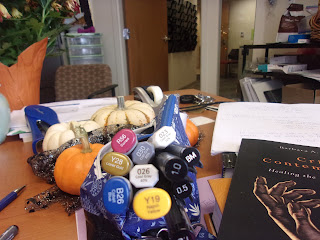
I began by posting a picture of the markers I would use:


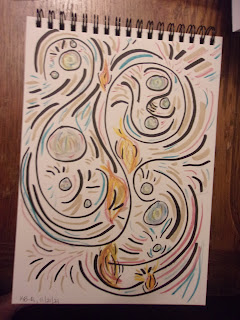
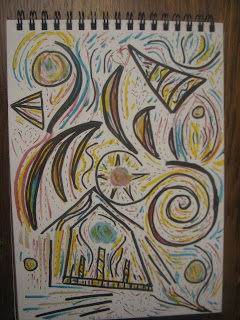
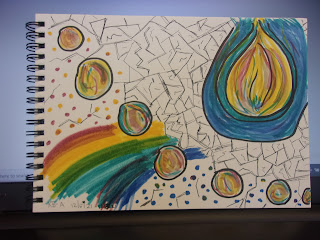
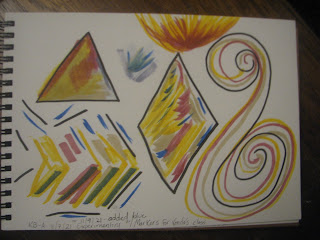
A first sketch--first I was undecided about having a blue marker, but I remembered the power of blue to create green. This morning, I added the bowl of flame shape, as I tried to see how deep an orange I could create. As I was creating the image in the bottom left, I was thinking about arrows and arrowheads, broken treaties and different directions, but I haven't started the book yet.


-------

This afternoon, on p. 13 in the Preface Practices, how we came to know our family histories. For me, it wasn't in the genetics or DNA, but in the stories we tell or were told, the connection to both farms and mountains, the faith that gets seeded (or lies in fallow soil) for each generation to sprout/grow/harvest in new ways:


---------

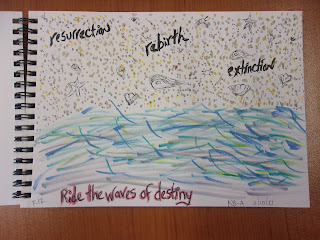
Here are two sketches that I worked on at the same time, inspired by this quote on p. 12:

"Once the unthinkable crisis has us in its clutches, we have no choice but to let go of our false sense of control and ride the waves of destiny. On the other side of this wild ride awaits extinction, resurrection or rebirth."


------

I don't have a sketch to go with this quote, but here's what jumped out at me from my lunch reading; her words from the acknowledgements demanded to be written down and shared: "When I look back on a lifetime of teaching and learning, I am thankful that I earned my degrees later in life. By then, I understood my gifts and my shortcomings, my call and my communities of accountability. Although I recognize the dynamic nature of the word 'understanding,' my point is that I pursued graduate studies when it was far too late to indoctrinate me into systems thinking" (p.16).


-----
I am at a Lutheran women's retreat at a conference center by a lake in the middle of the Florida peninsula. This morning's walk brought spider web after spider web, some small, some draped across several surfaces, all spectacular. Then I read the first few pages of chapter 1 and thought about "freefall through our carefully woven safety nets of 'normalcy'" (p. 20):


-------

"Rather, we are reminded that human beings are a part of a community of inspirited life" (p. 27). I love the word inspirited (one picture with flash, one without):


-----

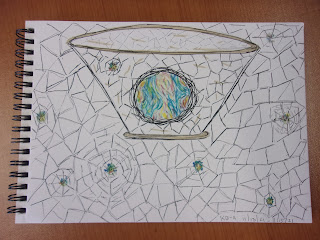
"The truth of the matter is that we live on a mysterious planet, with other living beings, whose interiority and spiritual realities that are just beyond our cognitive reach.

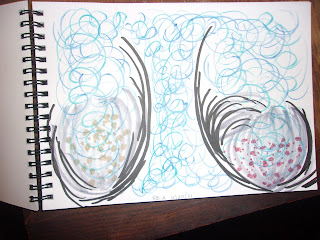
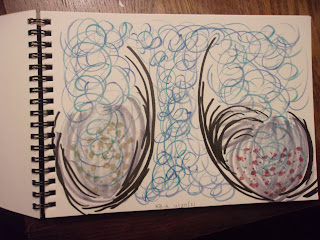
If life, as we experience it, is a fragile crystal orb that holds our daily routines and dreams of order and stability, then sudden and catastrophic crises shatter this illusion of normalcy" (pp. 19-20).

These words, along with the ones I wrote down earlier on Saturday, about safety nets and spider webs, were ones I was thinking of as I created this sketch. I was remembering the quote mistakenly, thinking that life was held in a fragile crystal cup, an image I also like.

------
I, too, was haunted by this idea:
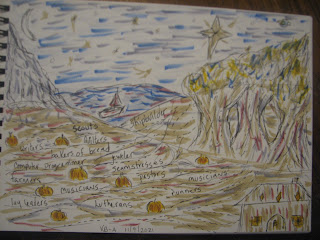
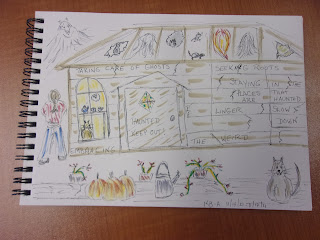
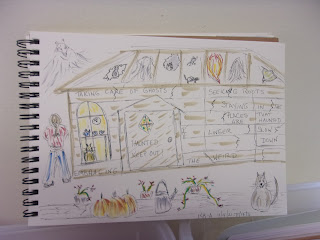
"Slowing down is...about lingering in the places we are not used to. Seeking out new questions. Becoming accountable to more than what rests on the surface. Seeking roots. Slowing down is taking care if ghosts, hugging monsters, sharing silence, embracing the weird...the idea of slowing down is not about getting answers, it is about questioning our questions. It is about staying in the places that are haunted. " Bayo Akomolafe, p. 39
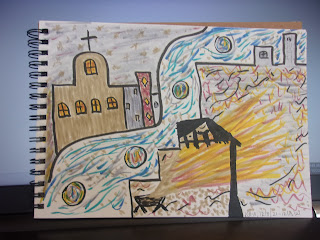
Process Note: My first idea was for a haunted house and I would put all the regrets that haunt me on the boards of the house. But I made the house too big, with no room for all the ghosts and monsters that I envisioned circling the house. And then these other aspects appeared: the woman on the side of the house, the stuff going on in the attic (not exactly sure what's going on there), the plants and pumpkins and cats and the table inside that's ready for tea. So instead of writing regrets on the house boards, I wrote parts of the passage.
I'm posting 2 versions of the same drawing, one with flash and one without.


--------
I have not made much progress with my reading. But this sentence did leap out at me: "In the darkness, we can gather in Spirit and be filled by this Source" (p. 44).
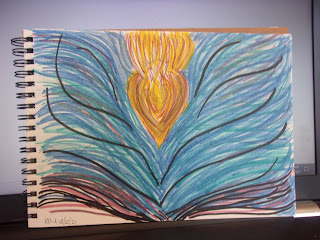
It's not the sketch I saw in my mind when I started, but it has some appeal (same picture, one with flash, one without)


------

". . . we fall headlong, together, into the power of divine intention and the mystery of an inner and outer cosmos" (p. 50).
Solar systems, the mind of God, inner wisdom, what the mind knows, what the body knows . . .


-------

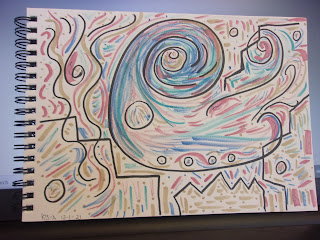
I was short on sketching time and short on connectivity last week. I did work on this sketch, which is less of a response to a specific passage from the work, and more what emerged as I thought about wounds and what it takes to heal (stitching, partners on a path, a way out of no way, protection of our soft spaces):


------

I haven't made it far into chapter 4--the first sentence made me reach for my sketchbook: "It takes a village to survive" (p. 83).


-------
Although I hadn't read any further in the book, I needed to keep my hands busy and my face neutral during a boring/aggravating meeting yesterday. So I worked on this sketch. This morning, as I read this quote, the sketch seemed to fit: "The child has recently come from the realm of the ancestors and the grandparents are on their way. There is much wisdom and special knowledge to be imparted between these generations" (p. 85).
I also see some Advent themes: unlikely wombs incubating improbable miracles, marginalized women saying yes to God's invitation.


-------
I confess that I was once again sketching without having a specific response to the text in mind. Today, as I looked at the sketch and text, this sentence jumped out at me: "Art opens a portal to new realities" (p. 98).


------
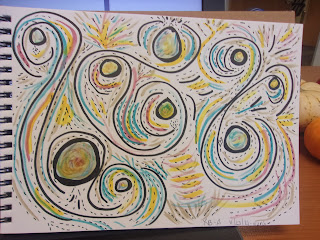
I created this one as I was thinking about lament. Before I started filling in the circles with color, my thought was that each circle would represent a lament. I also had in mind a tear (as in the drops one cries, not a torn spot) to the right of the page. The sketch went in different directions than I planned, but I still think it's an interesting response to the idea of lament.


---

"Although relief seems to be an impossibility, we know that we are embedded in a quantum world with nothing but possibility" (p.118).
"A liminal space is the time between the 'what was' and the 'next.' It is a place of transition, a season of waiting, and not knowing. Liminal space is where all transformation takes place, if we learn to wait and let it form us" (Jon DeWaal and Shonnie Scott quoted on page 128).


-----
"What is called for in times like these is a deep dive into unknowing, a trusting, and a liminal float in spiritual depths that sustain our collective wellbeing" (p. 129).


------

"We leap, trusting the glory of ancestral guidance, the blessed hope of the dawning of a new world order, and the promises of God" (p. 137).
The leaping didn't turn out the way I envisioned it, but I offer this sketch because the quote really speaks to me--what a way to close the book!


Thursday, December 16, 2021

Losing Fascinating Thinkers: RIP bell hooks and Anne Rice

Like much of the world, I felt stunned yesterday to hear of the death of bell hooks and how strange that it happened in the same week as the death of Anne Rice.  Oddly, I started reading both of them at the same time, for only a brief time, in the mid 90's.

Yesterday I saw everyone's grief spilling over on social media, everyone posting their favorite quotes and remembering the first time they read their favorite hooks book.  I felt that odd, left out feeling:  by the time I discovered her work, I had read other important works of intersectionality (race+gender+capitalism/clss), so her work didn't seem that radical to me, even as I understood that if I had discovered her when she was first published, I would have seen her as boundary breaking.  I remember buying a few of her books, underlining some passages, but later culling those books when I did one of my periodic purges.

Similarly when Anne Rice died earlier this week, I thought about how much she meant to so many people I know: Hank Stuever wrote a wonderful tribute article in The Washington Post that covers this territory so beautifully. I thought about how she challenged us to think about gender and sexuality in different ways, and how she will likely not get credit for that feat by scholars and critics in the way that say, Judith Butler gets credit.

Perhaps as time goes by, bell hooks will get more credit for her the ways that she explored intersectionality.   Yet she, like Anne Rice, explored popular culture, and in academic circles, that's a sure way to guarantee that one will lose out on some of the rewards that can come with serious academic study.  I realize that there are many reasons why bell hooks was at Berea College in her last years, but she didn't have a position in the Ivy Leagues, the way that some of her colleagues who explored similar territory (Cornel West, Toni Morrison) have had.

As I have watched the tributes pour in, I have been struck by how bell hooks continued to give back to a variety of communities, many of them underserved.  She probably could have had an Ivy League teaching job, but she went to Kentucky.  I love the pictures of her reading to children and the fact that she wrote books for children.  

I'm also struck by her willingness to follow her passions and interests outside of what various communities surely must have told her she should have.  It doesn't take much searching to find her writing on various music icons, but those are less interesting to me these days.  No, these days, I have loved reading about her encounter with Thich Nhat Hanh, for example, in this text.  

The world needs more of these kinds of interesting thinkers, like Anne Rice and bell hooks.  Let me sharpen my metaphorical pencils and get to work.