Monday, September 21, 2026
Hurricane Anniversaries: Hugo and Beyond
Sunday, February 1, 2026
Snow Day: The Fluffy Snow Variety
Monday, October 6, 2025
A Different Kind of Grieving: Hurricanes and Deconsecration
It was a good week-end, a 4 day week-end really with Fall Break included. With Fall Break included, it was a GREAT 4 day week-end, full of activities which nourish me, both literally and figuratively: cutting and stitching fabric, cooking and eating great food, writing a sermon and preaching at Faith Lutheran in Bristol (TN), reading and watching a wide assortment of recordings.
Every so often, a certain sadness crept in. We watched the PBS show This Old House, the 2 episodes of the current season where the team comes to the Asheville area to help rebuild after Hurricane Helene. I felt this odd mixture of grief and gratitude. It's a bit of survivor's guilt at how much damage we did not sustain during Hurricane Helene.
There's also some past hurricane trauma mixed with sadness about damage to past houses and my inability to make finances in South Florida work out. I say "my inability," but it's really not my fault--the inability is structural, both done intentionally (insurance policies and lack of decent jobs that allow people to afford necessities like housing) and some out of our collective control now, like the changes wrought by climate change.
There's gratitude that we sold the house when we did and got a lot of money out of it, something that will not be possible in years to come (and may, indeed, not be possible now). It was a weird mix of emotions that left me in tears on Saturday night.
I experienced something similar last night as we watched the Sunday service from our old church in South Florida. It was not just a worship service but the last service in that building. Over the past several years, a new worship space has been built, so the news is happy. There will be a gas station where the old sanctuary sat, so I have mixed feelings about that: hurrah for the money and new building that the church gets, hesitation about a gas station's negatives.
But as I watched the service, which included prayers and liturgy of deconsecration, I felt sadness sweeping over me. It's a ridiculous sadness in a way, not the least of which is that I'm no longer there. Other people have much more of a right to make decisions than I do--and I was part of the church council back in 2019 that unanimously voted to move forward with these plans. The sanctuary is a dark, dreary worship space--and yet, I feel this nostalgia for it.
I see my emotional state on both Saturday and Sunday night as a form of grieving, and it's not a grieving that gets discussed as much. I feel like my grieving makes no sense--I'm grieving a loss that got me/us to a better place. And yet, the losses are real.
I know enough about grief work that I know it's wise to let the tears come, to let myself feel both the grief and the joy. I don't need to talk myself out of feeling what I feel. The process will be much easier if I just let the feelings come. And so, I did.
Thus, that process, too, was part of what nourished me this week-end.
Saturday, September 27, 2025
Hurricane Helene, One Year Later
At this time a year ago, I'd be up and about, as I always am, doing some hurricane tracking, thinking about last minute packing. A year ago, my plan was to wait for sunrise and then drive to Williamsburg, where I was scheduled to lead a writing workshop at my mom's women's retreat. A year ago, I thought I might wait until mid-morning to leave, when I expected the worst of the rain from the remnants of Hurricane Helene to be over.
By mid-morning, trees were crashing all around our neighborhood. Thankfully, none fell on our house, but some of our neighbors were not so lucky. When I saw big trees across the neighborhood roads, I realized I wasn't leaving in the afternoon. I asked my neighbor across the street if she thought I could get out of town on Saturday morning. She said, "I don't think you'll be going on your trip."
She was right. By afternoon, North Carolina authorities advised that all roads in western North Carolina be considered impassible. Of course, I didn't know that, because I was trying to conserve cell phone power. Our power went off just before 5:30 a.m. and didn't come back on for over a week. Internet and water proved harder to restore. We did have running water for all but a few days. We had to boil it, but it did come clear out of the taps, so it was safe for flushing and relatively safe for showers (I was careful not to let any get in my eyes or mouth). We were without internet for 20 days, and happily, most days our phones could work as a hotspot.
This year, I am in Williamsburg, hoping to lead my writing workshop today. This year, it is raining, and I'm reminding myself that I am safe. This year, I'm saying a prayer for all those who will find today a tough day, with hurricane memories and other triggers.
Tuesday, September 9, 2025
Hurricane Irma Anniversary
Friday, August 29, 2025
Hurricane Katrina Memories, Twenty Years On
Twenty years ago, New Orleans was being slammed by hurricane Katrina. I've heard and seen a 20th anniversary report or two, and it's fitting that New Orleans gets the focus. We lived in South Florida at the time, and South Floridians have their own Hurricane Katrina memories, which can be dramatic, on an individual level.
I didn't watch the flooding of New Orleans happen in real time, or even see much about it. I remember hearing a radio snippet for a brief time when the power blipped on and then blipped off again. The levees had been breached, but had not broken. We know how that was about to turn out.
No, we were dealing with this:It's a downed ficus tree with my spouse and his chain saw (that pink blob) in the foreground of the picture. The standing tree stretched across the whole back border of our fence. The downed tree took up our whole back yard.
The pictures are grainy, because they've been scanned and saved through many formats. What you can't see underneath the green at the lower right is a smushed shed. Here's a better picture--that triangle of a roof was a shed that had been squashed by the tree:
The picture below gives a bit of a sense of perspective. Look to the left of the picture, and you'll see my spouse by the fence. You can see the twisted trunk of the tree rising in the center of the picture.
The hurricane flirts with us; like a reluctant
suitor, the storm cannot decide whether or not to commit
to us. It won’t even make a definitive date.
We watch it vacillate, wonder
if it might decide to court another.
Why do these storms always arrive at night?
They party with Caribbean island after island,
leaving the coastal wife watching the clock
and waiting for its arrival, keeping the lights
lit and the supper warm.
The storm should sneak in, with a whisper of wind,
A dozen roses of rain, leaving a bit of sleep
to the exhausted wife of a coastline.
Instead, the hurricane roars in, renouncing
all others to embrace us fully.
Like a battering spouse, it smacks
us again and again. Not content to just hit
until we back down, it smashes
us to unconsciousness and rips
our most beloved possessions to shreds.
We clean up the damage while we try to soothe
the little ones. We try to convince
ourselves that it won’t happen again. The weather woos
us with calm surf and skies full of sunshine.
We continue in this marriage. We cannot divorce
ourselves to head to the passionless calm
of a chillier climate.
If you want a book-length treatment of hurricane Katrina in poems, I recommend two wonderful books. Patricia Smith's Blood Dazzler does amazing things, an astonishing collection of poems that deal with Hurricane Katrina. I love the way that Katrina comes to life. I love that a dog makes its way through these poems. I love the multitude of voices, so many inanimate things brought to life (a poem in the voice of the Superdome--what a cool idea!). I love the mix of formalist poetry with more free form verse and the influence of jazz and blues music. An amazing book.
In Colosseum, Katie Ford also does amazing things. She, too, writes poems of Hurricane Katrina. But she also looks back to the ancient world, with poems that ponder great civilizations buried under the sands of time. What is the nature of catastrophe? What can be saved? What will be lost?
Here's a more recent poem, written years after after Hurricane Wilma (which wreaked devastation just 2 months after Katrina, just after we had finished up our hurricane Katrina clean-up) when I found myself weeping in the car, flooded by post-hurricane despair, even though the clean-up had been done and regular life mostly restored:
What They Don’t Tell You About Hurricanes
You expected the ache in your lazy
muscles, as you hauled debris
to the curb, day after day.
You expected your insurance
agent to treat
you like a lover spurned.
You expected to curse
your bad luck,
but then feel grateful
when you met someone suffering
an even more devastating loss.
You did not expect
that months, even years afterwards
you would find yourself inexplicably
weeping in your car, parked
in a garage that overlooks
an industrial wasteland.
Saturday, June 21, 2025
Saturday Snippets with Apocalyptic Reading
Some part of me thinks it's now mid-July; Thursday's Juneteenth holiday has fast forwarded that part of my brain. Let me capture a few moments from the past week that I haven't already captured.
--I've made it through two weeks of chaplain training. I am still exhausted by the end of the work day, but happily, my spouse foresaw this development, and he's patient. I am glad that I don't have little children.
--Last night was one of those nights where I couldn't even focus enough to sew or sketch. Happily, I was still able to read. Usually I choose something light, but last night, I turned back to Mark Lynas' Six Minutes to Winter: Nuclear War and How to Avoid It. I bought it a month ago, read the part that I read as the LitHub excerpt, and then put it aside, where it got buried under a stack of papers. It is one of the grimmest description of nuclear aftermath as I have ever read, even grimmer than the movie Threads. It was so grim that it was almost not scary. It's not exactly new information--after all, we've known about the possibility of nuclear winter for decades now. But the book spells out in detail what that would mean in a way that I haven't seen before.
--I was happy to turn my attention to Paul Murray's The Bee Sting, nominated for the Booker Prize in the same year as Paul Lynch's "Prophet Song." Maybe I'll spend the summer reading 2023 Booker Prize nominees.
--I spent part of Thursday stocking up on groceries: nuts, flours, beans, some canned goods like tomatoes. I have plenty on hand for lunches and dinners. My breakfast remains the same: oatmeal with nuts and dried cranberries, and I'm well stocked for breakfast too.
--I have bought a few more clothes and an extra pair of Saucony running shoes. Most of my shoes are several years old, and I need more cushioning.
--I am trying to get two sermons ready for tomorrow, since I will be at the hospital on the last Sunday in June. Yesterday I wrote a draft of next week's sermon by hand as I ate my lunch. I'll be interested to see how it stands up as I type and revise today.
--On Wednesday, I wrote most of my Noah's wife (as in Noah and the Flood in Genesis) as hospital chaplain poem, again by hand during lunch. I am pleased with the draft, and here, too, I look forward to seeing how it holds together when I type and revise.
--Here's one stanza of that poem:
She has already witnessed
the end of the world,
the disaster that destroys everything.
She can be a non-anxious
presence to everyone in the hospital.
She has seen worse.
--It is time to get ready to go to the Mills River Farmer's Market. The Saturday before Hurricane Helene, I bought a basket of tomatoes from my favorite farmer, and he said, "Just bring the basket back when you can." After Helene, I couldn't get back to that market, and it might not have even been open. But I'd like to return the basket if I can, and I'm not sure what my Saturdays will look like for the rest of the summer.
Friday, March 28, 2025
A Week of Smoke, A Week of Encouragement
It has been a strange week, a wonderful week, a tiring week, a good week overall for me personally but not so much for larger communities. Let me record a few snippets.
--It's been the week when we've learned that some of the highest federal government folks have been talking on unsecured networks; this week's scandal has been dubbed "Signalgate." I've been shaking my head, as many people have. Many of us have had to go through yearly trainings to remind/teach/train us of the importance of keeping secure information secure. And one doesn't need these trainings--it's common sense. Grrr.
--It's been a week of other kinds of smoke. We've had lots of fire in the Carolina mountains. So far my house is safe, but the smoke is visible, and the air quality is poor. As I drive back and forth to Spartanburg, I can see huge plumes of smoke in the distance. We need rain, a few days of soaking (but not torrential!) rain. More than that, we need the downed trees cleared away, but I'm not sure how that will happen.
--We've had family members in town as one of the next generations scouts wedding venues. It's been great to be with them. It was too brief, but brief visits are better than no visits.
--My seminary schedule is a bit strange, with lots of due dates next week. The good news is that by getting this work done now, I'll have less to do later. But I am feeling loaded down.
--The two classes that I'm taking have been particularly good this week, so that's a blessing. And I've gotten good feedback--much needed encouragement, encouragement needed because I'm tired, not because I'm doubting myself.
--It's also been a good teaching week, with encouragement and praise. It's nice to feel appreciated. And it's a marvel to be praised for all the things I do, like the quilting bee on Monday. I've worked at many a place where people would have questioned what any of that had to do with writing an essay, with the insinuation that I should just do my job. And it's nice to be in a place that has space to do a quilting bee.
--I had students who came to the quilting bee who wanted me to do it again, and one student who wishes I would teach a sewing class. I wish I had those kind of sewing skills. I can't take a pattern and cloth and end up with a shirt.
Even though it will be an intense week-end getting next week's seminary tasks done, it will be good to have a day when I'm not driving. It will be good to have some time to get the work done.
Tuesday, December 31, 2024
A Look Back at 2024
I don't always do an end of year retrospective; some years I'm on vacation, while other years, I just don't feel like it. But today, reading the retrospectives of other people, I've decided to put one together. It's good to remember that there were good times and bad, goal met and not yet met and abandoned, books read, that kind of thing.
Teaching
Let me begin with teaching. I've continued to teach online and in person. I've had days when I thought, this is what I was put on earth to do! There were plenty of days when I wondered if I'm too old to do this anymore, but mainly because there are so many cultural references I'm not going to get. But my overarching feeling is that I am ready to step into my wise elder shoes--I'm much more assertive about forbidding cell phone use in class, much more willing to assert that some experiences are important (we will create a communal poem, we will describe a tree that we've spent 20 minutes observing, we will continue to assert the primacy of literature).
Seminary
I continued to take a wide variety of seminary classes in a wide variety of modalities. I am still really enjoying this work. In the past year, I took 9 classes, no small accomplishment, particularly in a year of a devastating storm that made life very difficult (no electricity for 2 weeks, no internet connectivity for 4 weeks) for an online student.
Writing
Much of my writing focus has been seminary work and writing a weekly sermon. It's been delightful, but there are times when I feel odd about how much poetry writing I haven't been doing, along with other writing. But I did write 30 poems of varying degrees of completeness, along with at least that many fragments. I have continued to blog daily throughout much of the year. I have kept an offline journal and sent e-mails to friends, along with letters. Writing is still one of the ways I figure out myself and the world.
Sketching
I have done some sketching on a daily basis. As I looked at my sketchbook, I'm struck by how I'm trying to capture the mountains in sketching, with varying degrees of success. I've written more about my year in sketching in this blog post.
Fabric Arts
I have continued to stitch, although there have been too many weeks in the Fall when I did not touch fabric. At the end of the year, I have a new quilt top almost completed, a quilt top I didn't even have in my head at the beginning of the year. I have loved being part of a group at the local Lutheran church that makes quilts for Lutheran World Relief.
Reading
I have done a lot of reading for seminary class, which means I haven't done as much other reading as I would like. I read at least 70 books, including some rigorous academic books outside of theology. I would like to read more poetry in 2025.
Theatre and Museums
We saw great theatre, but it was in our home, which may be one of the better ways to see it (it's cheaper, and we can see more). I went to one special exhibit at the Columbia Museum of Art, which I wrote about in this blog post. I also went to the Smithsonian, back when I was in DC for the seminary onground intensive, which I wrote about in this blog post.
Music
We had great musical experiences at camp during Music Week. We had plans to go to a concert or two, like the Violent Femmes, but Hurricane Helene disrupted those plans.
Health
I continue to work on solid practices that will situate me for an easier old age: more walking, more vegetables, more strength training, more gratitude, more creative time, more friends, less alcohol, less sweets, less screen time. Most months, I'm partially successful in most areas, and most of the time, I think that's about all I need to worry about.
Hurricane Helene
One of the things I will remember most about this year is Hurricane Helene, the fact that we moved 900 miles away from our South Florida house in a flood zone, only to be impacted so severely by hurricane remnants, from a hurricane that came ashore hours earlier and hundreds of miles to the south. We are 2000 feet above sea level, and the damage to the geography was much worse than any hurricane damage I've ever seen with my own eyes. Happily, our home was not damaged, and we did not lose a single tree.
Home Renovation
We made progress on home renovations. A year ago, we still didn't have much in the way of internal walls; now we do. A year ago, we didn't have any bathroom restoration done; now, we have two bathrooms that have been modernized. There is still work to be done, but there will always be work that needs to be done.
Politics and Other Major Events
The presidential election had lots of surprises, which shouldn't be a surprise. But I am guessing that in some future year when we look back, across a space of decades, we'll be surprised at what we all missed, what huge historical event we didn't see coming. If the more deadly form of bird flu mutates to become transmissible from human to human, that might be the story. If it's a war with China or that Putin detonates a nuclear bomb, that might be the story. Or maybe it will be an unexpected human rights advancement. I think about January of 1989 when no one would predict that this would be the year that the Berlin Wall came down and dictators across Eastern Europe would be deposed.
Friday, November 29, 2024
The Morning After Thanksgiving
We had a great Thanksgiving, just the way I love the holiday: full of cooking and good food. There were other elements, too, like family members who were happy to be together. This one feels luckier to me, because I know it's not always this way for many people, and it can be much harder to make the family piece come together.
My spouse and I got up early to head to his dad and stepmom's house. We had an apple pie to create and bake, before the cooking of the 20 pound turkey. My spouse peeled and sliced the apples, and later in the morning, I took over as assistant to the main course cooking. We got the turkey ready and in the oven. We created casseroles and pans of dressing. I made a gravy out of drippings.
Eventually, others came, and we got ready for the feast. First, we went around the circle to tell what we're grateful for, and the lists were not surprising: friends, family, good fortune, moving 1000 miles away to escape hurricanes and surviving the one that found us in the North Carolina mountains (O.K., that last one was surprising). And then, the real surprise: a marriage proposal! Our only niece said yes to her significant other who got down on one knee after taking a ring box out of his pocket.
We settled in to enjoy good food and good wishes and even more gratitude. The clean up was surprisingly easy, and there will be leftovers later today, after pie for breakfast.
It has been an autumn of disruptions, in one way, an autumn of wreckage and ruin. But there is beauty in this brokenness. It has been good to have a chance to celebrate this holiday with a different set of family members. It has been good to remember that if we're lucky, wreckage can prompt resilience.
Having said that, I'm ready for a season that doesn't fall apart, a season that doesn't require a constant shifting of my attitude.
Sunday, November 24, 2024
Humdinger of an Autumn
Way back in August, a friend and I discussed the upcoming autumn. My friend said, "It sounds like you've put a lot more on your plate without taking anything off." I agreed, and I said that it should be doable, as long as nothing went wrong.
Back then, when I thought of the things that might go wrong, I thought about illness or a death in the family. I thought about the ways that events might keep me from getting to campus for the online intensive, like illness or car trouble. I thought that I might get hopelessly behind in my grading and never catch up--truthfully, I have been less worried about this possibility, since I've been teaching for 35 years, and that's never happened.
I did not think about a hurricane making it this far inland and doing so much damage over the mountains of North Carolina. I did not think that I wouldn't be able to get to the retreat I agreed to help lead, and I did not think that the synod event would be cancelled. I did not think that my spouse would hurt his back and leg helping with hurricane clean up and need so much help to get through the day, as he did last week. I did not anticipate that my seminary would have more demand for housing for the onground intensive than they had space.
So far, though, we have managed to pivot and punt and keep everything going. I am grateful for that. More than that, our various struggles have revealed strengths. Our community came together to help each other after the storm--both my neighborhood and the larger western North Carolina community. My seminary professors were supportive as were my employers, in terms of post-storm internet access difficulties. My spouse had very good sessions with various parts of the medical community on Friday. I had to miss a day at Spartanburg Methodist College, which wasn't a problem--how refreshing to work for a school where faculty are treated like professionals, not like troublesome children who need to be punished, and how sad to think about how rare it is to be treated like a professional.
As we shift to Thanksgiving, let me remember all that makes me grateful. And let me remember to be thankful for how much there is that makes me grateful.
Friday, November 22, 2024
What Is Government Good For?
In the past weeks since the election, I've been surrounded by news of the incoming administration and all the people who hope to take charge of government, many of them hoping to change it profoundly. At the same time, I've been seeing so much evidence of how government can work well:
--Last night I went to the public library. I have lived in a variety of places across the southeast U.S., and the public library is always such a delight. I have saved a bundle on books I would have otherwise bought, but the public library is so much more than books. There are meeting spaces and presentations and English language classes happening. Every so often, there's voting. There are lots of children, who are so happy to be in the presence of so many books. There are computers that anyone can use, and there are often people to help those who need to use a computer but don't know how.
--The city of Asheville restored potable water a month before expected. This happened in part because of local experts who work for city government and also because of the Army Corps of Engineers. The government experts gave daily briefings to explain what was happening and the progress of restoration. I now know so much about what it takes to give us safe and clean drinking water, and I am grateful for government water projects that have made it possible.
--The devastation of the water treatment plants is hard to fathom. It could have been much worse. At the North River water treatment site, there was a shut off feature that was installed, a shut off feature that didn't rely on a human to hit a switch. If that hadn't been there or if it had failed, the dam would have failed, and everything and everyone in the thirty miles between Black Mountain and Asheville would have been destroyed by water. It was the government that approved the money to add that shut off feature.
--I know that it is government agencies that keep our food safe, as well as our water. I am planning my American Lit survey class, and the Norton Anthology has a selection from Upton Sinclair's The Jungle, which I'll probably assign. My students need to remember/learn what it was like before we declared food safety as a common good, worthy of regulation.
--I am thinking of my years of public schooling. With the announcement of the death of the man who invented the BASIC computer programming language, I thought about my own experience programming a computer in the 7th grade, about the computer that took up a small room, and our delight in learning how to write simple code. I'm thinking of the shop classes I took and the home ec classrooms that had stoves and refrigerators and equipment of all sorts. I'm thinking of the pottery studio that had a kiln. I'm thinking of band rooms and instruments and all sorts of sports.
--Public schools and other public programs keep children fed. Summer camps run by local governments keep children safe. I realize how much can go wrong and how much does go wrong. But so much goes right, in community and community, across the U.S.
I will conclude by saying that I am hopeful, even in the face of a new administration that has vowed to cut government. Maybe they will get rid of waste, and that can be a good thing. Maybe they will create new approaches, and that can be a good thing.
I've been alive long enough to know that if an administration tries to get rid of an institution that enough of us value, it won't happen. Let that continue to be so!
Tuesday, November 19, 2024
Good News, Bad News Hurricane Recovery
Yesterday was the first day in over 45 days where we didn't get multiple phone calls from the City of Asheville telling us to boil the water that was coming out of our taps. Yesterday we got the word that the boil water notice is lifted. I emptied the last of the boiled water into the pitcher, my daily ritual. Yesterday, I didn't boil more water. It's been interesting to find out how much water we use for cooking and drinking--about a gallon or two a day, depending on whether or not we're home, whether or not we're cooking.
Some people went online to proclaim their jubilation. I am tired, and part of me is always waiting for the other shoe to drop. I try to do the things that help me maintain mental equilibrium. On Sunday, I went for a walk, up to the chapel, to the outdoor altar where I planned to sit and breathe for a bit.
I saw smoke as I walked up the hill, and I expected to gaze out to see smoke drifting from a distant mountain. Instead, I saw flames on the other side of the hill where the Quiet Way path would take hikers up to the chapel, flames not too far away from where I stood.
I called the camp director before I called 911--in retrospect, that was stupid, but I wanted to make sure they weren't doing a controlled burn. Nope, and he had called for help. I walked quickly back down the hill, and then went down to a fork in the camp road to make sure to flag the trucks to the fire, should they come in the back entrance.
Happily, the response was quick. I walked back up to make sure there was nothing more I needed to do. The very kind fire fighter I chatted with briefly told me that I should never hesitate to call 911, that they often arrived to find fires under control, and those were happy days.
I have been worried about fire since the early days of hurricane recovery--so many trees down, and such a dry October and November. I am glad the fire was contained, but worried about what would have happened if no one had been around/awake to see the smoke and flames, as several of us did.
I am also worried about the health of my spouse. A few weeks ago, he did something to his back while helping with the chainsaw to get trees cleared. It comes and goes, and just when I think we've turned a corner, he has a flare, a sciatica kind of pain. Yesterday was a very bad flare. Luckily, he has a doctor's appointment for his annual physical on Friday, so maybe we will discover that there's something that can be done.
My spouse's experience makes me worry about the future. We do not live in a country that has lots of options for people who need more care than I can give--and with Trump in charge, I don't foresee our nation ever evolving that direction. The long term outlook might terrify me, if I really let myself think about it.Friday, November 1, 2024
Hurricane Debris and Early Voting on Halloween
Tuesday, October 29, 2024
Halloween Approaches: Haunted by the Ghosts of Halloweens Past
Halloween approaches. I have been having slightly scary dreams, the kind where I know that something bad is about to happen, so when I jerk awake, I decide not to drift back off. Last night it was a sparkling ocean with moving walkways on slender spires far above the ocean, heading off to some final destination that seemed unlikely, but my mom had gone on ahead and didn't have her phone.
When I write it out, it doesn't seem as slightly scary as I thought it was when I was dreaming. Let me capture a few moments that seem to crystallize what this late October feels like:
--I heard a banging on the deck--something was clearly out there. I wasn't worried that it was a murderer or a burglar. Here in the mountains, I'm much more worried about bears. But it was a raccoon. I wasn't quick enough with my camera/phone. Now all is quiet on the deck.
--Last night, we saw one of the numerous ads for other Roku channels that run on the Roku channel we've chosen. The ad was for the Haunted channel, which reminded me that Halloween approaches, and I've barely noticed. Last year I was sketching witches and cats and big moons and haunted houses and pumpkins, like this sketch:
--This year, I spent my sketching time in October sketching broken trees:
--As we watched the promo for the Haunted channel, I realized that what I really want is a Halloween Lite channel, where we could watch It's the Great Pumpkin, Charley Brown and every Halloween special episode of Roseanne and other sitcoms.
--In past Halloweens, I've written poems about being the ghost haunting the house. This line popped into my head: "I am the haunted house." It doesn't feel particularly original, but it does seem like it would take me interesting places.
--As I looked through my camera files on the phone, I realize I've taken lots of photos. On my Saturday walk, I found this weaving of dried vines, still slightly curved from where it had been around a tree trunk.
I carried it with me and put it in various places as I thought about how it reminded me of a corset. If I had to title this photo, it would be "The Tree Removes Her Corset":
--Yesterday I noticed the shape of leaves on pavement from where they had been before. The brown is actually mud/dirt, which made me think of God or a storm painting in mud.
--I also thought of ghosts and hauntings:
--Today we will make our first attempt at early voting; if something should happen, we will make our second attempt on Thursday. The juxtaposition of voting and Halloween--lots of haunting possible symbolism there.
Monday, October 28, 2024
Wreckage and Ruin on the Way to Church
Yesterday I made the trip to Bristol, Tennessee, where I preach and preside at Faith Lutheran each Sunday. Yesterday I left at 6:50 a.m.; I took a book with me, in case I got there very early and needed something to do. Google Maps told me that the optimum route would take me 2 hours and 10 minutes; it took me 2 hours and 45 minutes.
My spouse couldn't go with me yesterday because he's been recovering from the ways his body has been protesting all the chain saw work he did earlier in the week. I was feeling anxious, so I decided to print the Google Maps directions, in case I got to a part of the backcountry roads and lost cell phone service, which I assumed would mean losing GPS.
I started on I 26, with signs that said the road was closed at exit 3. I took the exit that got me to US 19, and that road was a 4 lane highway, straight and wide, with only one truck on it. I thought, well, this isn't too bad. There were trees blazing with autumnal color, and I thought, you wanted to experience autumn in the mountains--here you go.
Then I got on NC197, a two lane road, but still not bad. There were piles of debris here and there, a tree down here and there. I was behind an 18 wheeler and a box truck, but that was fine--I wasn't going to be zipping down these roads because I knew that they had only just been restored.
I got to Green Mountain, where the road ran by the North Toe River, and I saw so much devastation. I know I didn't take in the full extent of it because I was focusing on the road, which looked like it might crumble out from under us at any moment. The road had stacks of trees on either side, and I am fairly sure that crews just cut out the middle parts of fallen trees to be able to access the roads. On the other side of the river, railroad tracks had buckled and twisted, like some huge child had a temper tantrum.
As I went up NC226, up and up the mountain, I saw portions of the mountains where every tree had been flattened. Yet there were other sections in the next curve of the road that hadn't been touched, trees in full autumnal glory. The road got curvier, and I felt increasingly anxious--there was no shoulder at all, and the 18 wheeler truck ahead of me felt free to use both lanes to navigate the curves. What if there had been oncoming traffic?
Eventually, I pulled into the parking lot of Faith Lutheran. I felt frazzled, but took some deep breaths and pulled myself back together again. Just 20 miles earlier, I had been in Elizabethton, Tennessee, where a different river had overswept its banks and destroyed everything in its path. And here I was in Bristol, where the community was largely unharmed.
When I think of October, I think I'll remember this feeling more than any other: how can some of us suffer so much damage, while others of us (me, for example) emerge relatively unscathed?
On the way home, my smart phone routed me down I 26, and I decided to follow its instructions. If I was turned away and had to backtrack, I had time. The road was closed at exit 3, at Irwin, NC, but the detour was clearly marked. I got back on I 26 and went back across the mountains that way.
The damage at Irwin was as catastrophic as the news reports made it seem, with wrecked roads and houses no longer there, swept away when the Nolichucky River rose. I remember last winter when all the leaves were down, and I realized what the true contours of the river were, how some of the houses weren't too far away from that wide river. I think those houses are gone now.
There weren't many of us going across the mountains, but as I got closer to Asheville, traffic increased. I got gas at the station near my house. It's always crowded, because the price is cheap, but yesterday was worse than usual. I was glad to get home; I've been through hurricanes before, and I know there's a point when the "we're all in this together" phase of recovery shifts to despair and rage as the pace of recovery takes so very long.
At the end of the afternoon, with no fanfare at all, we realized that our internet had been restored. I spent the rest of the day, expecting it to go out again, but so far, it has held. I'm still boiling several pots of water a day, but that inconvenience is so minor, compared to the wreckage and ruin I witnessed yesterday.
A single picture and even a series of pictures can't really do justice to the scale of the wreckage and ruin. Neither can these words. I've seen article after article that tells of people swept away in the raging rivers. Those words, also, can't make sense of it all.
On some level, humans aren't equipped to make sense of destruction on this scale, whether caused by nature or caused by humans. But as with the pandemic, it makes sense to create a record of what I've seen. It may never be important to historians, but it's important to me to bear witness.
Saturday, October 26, 2024
Writing, Sketching, Writing
In my office, I have a bag of leaves. In mid-September, they were brilliantly colored when I picked them up off the ground. By afternoon, when I used them in class, they had started to fade. I had my English 100 students write descriptions.
I thought about having them sketch and then write again--would the writing change? I didn't have pencils, so I decided to revisit that idea later.
The day after the hurricane, I noticed all the acorns and pine cones on the ground. I decided to pick them up. I made sure to pick up enough so that each student could have an object. When I picked them up, I had no idea it would be so long before I returned to my in-person classes.
This week, I tried an experiment. On the first day, I had them choose either a pine cone or an acorn off the desk. They wrote a basic description of the object. I then had them write a creative type of approach: write in the voice of the object--what does it have to say to us?
I then made a list of items on the board: weather related (hurricane, rain), places in nature (mountains, volcanoes), other objects from nature (stone, river). I had them write again--choose an item from the board and have it speak to your object or create a dialogue.
Then I had them choose six of the most interesting words from all the day's writing and hand them in. I have created a word list that we'll use next week.
The next class day, I had them choose the same object from the table. I had white paper and pencils for them. We began by drawing the object.
The room was amazingly quiet. For the first chunk of class time, everyone concentrated on sketching. And here's what really astonished me: no one reached for their phones. It is the only--and I mean the only--time in the class where no one even considered reaching for their phone.
We did a variety of sketches. My favorite was a variation on an exercise that we did in a seminary class (which I wrote about in a blog post). I had them divide the paper into 6 squares. We sketched for 30-40 seconds and then switched squares--quick, quick, quick.
And then I had them write a description of the object again. I had the students compare the two writings, and we discussed what they saw. Some of them said they wrote in more detail after sketching. Some did not.
We talked about the value of doing something else, like sketching, an activity that wasn't going to be part of the grade. I talked about the value of taking a break from intense studying or writing.
In English 101 class, from October 21-Nov. 1, we're doing a variety of these kinds of approaches, and then students will write an essay about what we did, what they experienced, and analyzing the effectiveness of these activities. I've done variations of this kind of writing project before, and the writing has been phenomenally better than more "standard" essays.
But more important, watching my students sketch and write helps me feel less exhausted. It helps me feel like we're doing something post-hurricane to return to normalcy and to affirm the value of writing, sketching, and other endeavors.
Friday, October 25, 2024
Hurricane Helene Leaves New Vistas
Another day without in-home internet access. My phone-as-hotspot workaround is working, but I'm much more careful. Yesterday morning, I listened to a conversation on video that's required for one of my seminary classes. In pre-hurricane days, I might have assumed I could do that in the evening, but I got it done early in the morning, when I can be sure that the hotspot will work. On Monday, it worked for my Zoom session that is required for a different seminary class, but it did freeze several times, and I had to sign off and log back on. Happily, my professors know my situation, and they let me back in.
But it could be worse. One of my colleagues at Spartanburg Methodist College still doesn't have running water. Another's spouse lost her very successful business at Biltmore Village and is reassessing what the future looks like.
It was four weeks ago that Hurricane Helene blew through our area, and I am still astonished at the amount of the damage that was done. After all, this was just a tropical storm, not really a hurricane when it came to us.
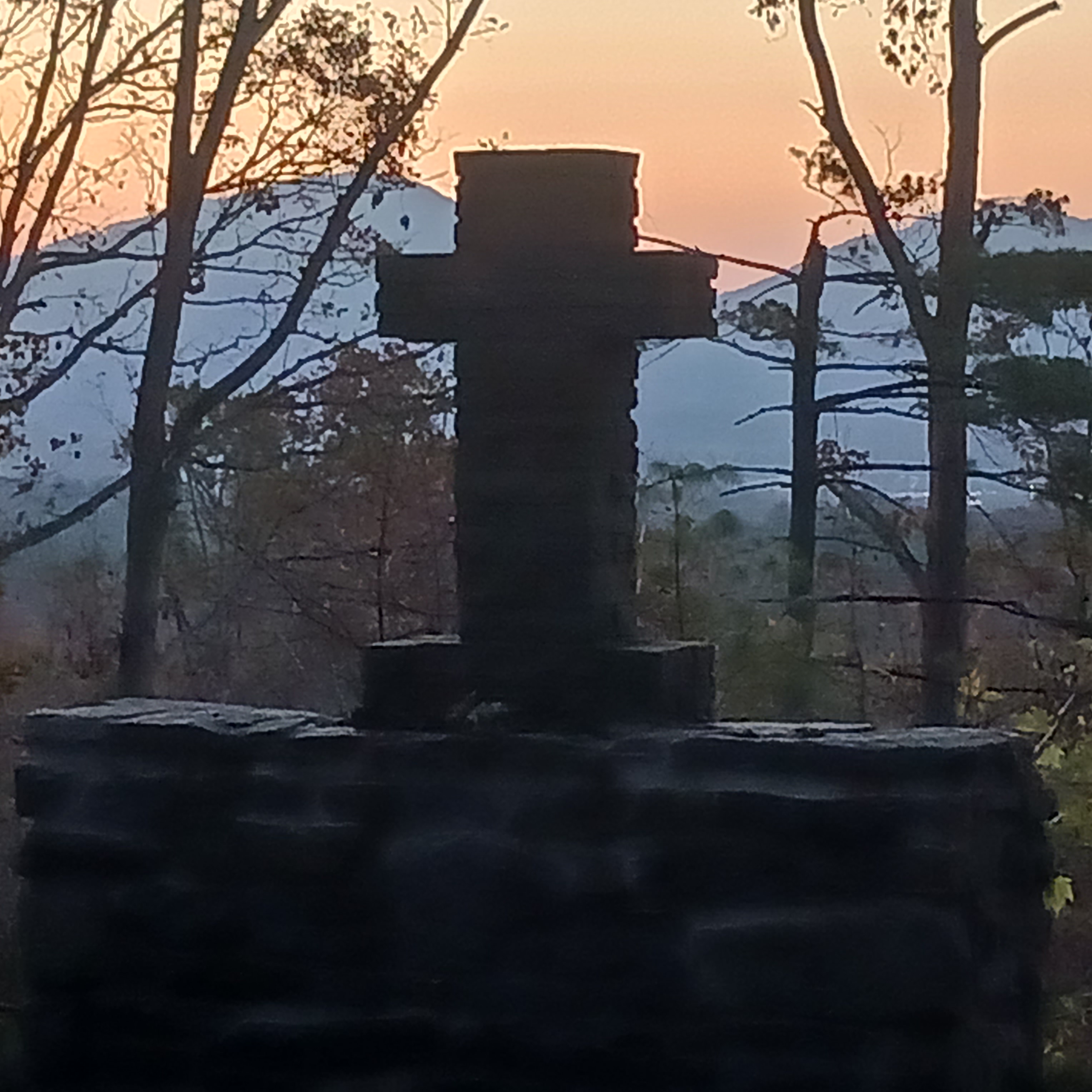
Yesterday I walked up to the chapel. I didn't have much time to walk, so I stayed up there, taking pictures as the light changed. I wanted to be there when the sun finally rose over the mountain.
I am sad about the loss of trees. I'd give up the beautiful mountain views that are left behind if we could magically have the trees back. But since that's not possible, let me appreciate what has been left behind.
I know that other trees will now have a chance to grow and take their place. Future generations will have a different view.
Hopefully this cross and meditation space will still be here for them.
Monday, October 21, 2024
Back from the Seminary Onground Intensive
Yesterday’s journey back across I-40 was a sobering reminder of how much worse it could be. Sure, I began the day by boiling water, but at least it’s clear water, so I can have a hot shower later—some people still have water with so much sediment that they can flush toilets but not use the hot water heater. I still have a house where I can boil water and sit in safety, with electric lights and heat.
Yesterday’s trip across the mountains was much better than the one I had a week ago. Of course, I left at 5 a.m. to better my chances of having a better trip. Back in the before-hurricane time, I had planned to come back on Saturday, thinking I would need to go to Bristol to preach on Sunday. When it was clear that roads would not be clear by yesterday, I made the call to send in my sermon. I stayed an extra day because my folks were in town, and with my sister in Maryland, we had a mini-family reunion.
A week ago, I’d have been getting ready to make the drive to the seminary campus in DC for the onground intensive. I didn’t leave quite as early because I thought the traffic would be lighter because of the Monday holiday. Friday turned out to be the easiest commute. Traveling back and forth to campus every day made me very glad that I don’t have to travel back and forth to campus every day.
It was good to be on campus having in-person discussions. It was good to go on a field trip to the Museum of African American History. Our Biblical Storytelling class benefited from being together to have the experience of performing in front of a live audience. And of course, I enjoyed the return to the campus itself—I saw a few faculty members and friends from the time when I lived on campus and took classes.
But I don’t know that I would do an onground intensive again, especially not if I had the kind of job that would require me to take vacation/leave time to do it. I can accomplish most of the same things by way of virtual classes meeting in real time, and it’s less disruptive. And of course, there’s the cost (of travel, of lodging, of food), which I almost always forget to factor in.
This week, I need to help my Spartanburg Methodist students back on track. I have a plan, and I will be gentle with us all. One day at the intensive, I was startled to realize how little time there is left, what a gaping hole in the schedule we have had. I tried to keep my attention focused on the seminary class I had traveled so far to take, but it was an effort.
I imagine that much of the next two months will be like that: trying to stay focused on the task at hand, trying not to be overwhelmed by all that is still left to do. Of all the things that I thought might disrupt my jam-packed schedule, I did not think it would be the remnants of a hurricane blowing through the North Carolina mountains!