Showing posts with label online resources. Show all posts

Monday, September 14, 2026

Satisfying Sunday

Yesterday was a fairly good day.  At church, as I was moving through the communion liturgy, I could feel my throat about to crack, and sure enough, I went into a coughing fit.  Because I was at the words of institution, I felt weird about having someone else speak the words--Lutherans believe that only ordained or specially appointed ministers can consecrate the bread and wine.  I think it would have been fine, as long as I was there, but I don't really know how members feel.  So I drank some water, coughed a bit, and powered through.  People were kind.

I have spent most of the week wondering if I'm fighting off a cold:  I'm more tired and less hungry, and my throat has felt a bit scratchy off and on.  And I'm still not here.

I felt good about my sermon, although I'm aware of all the ways it could be improved; you can view it here on my YouTube channel and read it in this blog post).  We spent Sunday afternoon as we usually do, watching other people's sermons from churches where we feel a connection.  No one else preached on the Gospel.

I wanted something else of depth before we reverted to our usual viewing of old TV shows like Whose Line Is It Anyway?  We watched this podcast of David Brooks interviewing philosopher Meghan Sullivan. My spouse and I both have solid liberal arts educations along with graduate degrees, so it wasn't groundbreaking for us, but it felt nourishing.

I did some stitching in the evening so that I stayed awake past 7:15--success!  I'm making smaller squares, the first level of a log cabin square--but they're not all the same size.  I may put them aside and go back to the quilt I'm making for my cousin's first child who graduates from high school this year.

And now, another week:  week 6 at one school, week 3 at another.  We've got sanding to finish at the fixer-upper house.  The work at Faith Lutheran continues.  Onward!

Friday, August 14, 2026

First Week of School: The More Things Change

It's an interesting moment in time to be teaching first year students.  I mean that in a broad sense, but I also mean it in a "teaching the first week of classes during this particular week in August of 2026."  Let me unpack that statement a bit:

--Tuesday March 11 was our first day of classes.  It was also my first day as an Associate Professor on the tenure track at Spartanburg Methodist College, which I wrote about in this blog post.  Just before I went to my first class of the Fall 2026 semester, I read this article in The Atlantic about a professor leaving his tenure track job.  His college, Bates College in Maine, is in many ways completely unlike mine.  The beginning of the article made me think I was reading the complaints of an incredibly privileged man who got a teaching job right out of grad school, but it's more nuanced than that.

Here's the 5th paragraph (the nuanced part comes much later):  "When I defended my dissertation on Zoom that spring, one of my advisers joked that seeing me with a tenure-track job in hand was like 'watching the last dinosaur being born.' It was at once a compliment and a grim acknowledgment of reality. I had won the lottery in an apocalypse. I was going off to the kind of secure, prestigious, fairly remunerated academic job that was rapidly going extinct in a world where most people teaching college courses were stuck in the permanent underclass of contingent labor."

Most teachers I know are somewhere in between:  certainly not prestigious institutions, but not adjunct work either.

--As I drove home on Wednesday, I listened to this episode of On Point, which talked about reading, both in light of the state of Texas requirements announced very recently, and in terms of whether or not children are reading whole books at all.  It made me nostalgic for my own days of reading in elementary school and made me think about what we read in high school, where we did read whole books and plays.

I don't assign many whole books these days, and I feel mostly good about it--but the show made me wonder if I'm right.

--My students will be doing more writing, the old-fashioned kind with pens and paper.  Most of my department colleagues are also shifting back to paper.

I came across this Substack post that talked about what writers should be doing to prove that they did their own creative writing, should a publisher feel the need to have a writer justify their work.  As a poet, I'm not too concerned.  The post did point out how much formal writing, the old-fashioned kind that academics learn to write, will be flagged as AI generated.  Here's what the author did:  

"I ran my PhD thesis. Atmospheric physics, submitted in 2010, at a point when the technology being accused of writing it was more than a decade from public release. Running it through a detector in 2026 returns around 70%.

A physics thesis is exactly the careful, formal, low-perplexity register that the Stanford study found classifiers flag.

A detector tells you one thing: that a piece of text resembles a statistical distribution. The question in the room is who wrote it, and no detector has ever answered that one."

--This week is also a week with more articles about AI run amok, a week when at least one more experimental AI agent got out of the boundaries/cage/safeguards.  My apocalyptic brain immediately thought of a future when we look back and laugh/rage/cry at the obsession with student/writer cheating and ignoring the much larger threat.

--It's strange being at a school where most of us haven't seen each other since early May, and I haven't seen students since late April.  It's not strange to me when students return looking different.  They are in late adolescence after all.  But some of my colleagues are notably thinner.  Maybe it's having time off in summer, but one colleague did tell me that she'd been taking a GLP-1 drug (another new technology reshaping our lives), and it was transformative.

I had hoped to be somewhat thinner when I returned to school, but I'm happy with feeling healthier.

Conclusion;  In some ways, the more things change, the more they stay the same:  I always want to return as a transformed version of myself--transformed in a good way--if I haven't seen people in awhile.  And yet, I'm seeing changes underway that may completely reshape the world, in the way that the atomic bomb did, and the way the end of the Soviet Union did.

Monday, July 6, 2026

Music Week Begins!

Yesterday was the start of Music Week at Lutheridge.  This year, unlike last year, I can be around for more of it.  I plan to go to the choral group (adult choir) rehearsals, so that if my Dad needs anything, I'll be there to help.  Plus, I don't mind being there when rehearsing is happening; in fact, I find it fascinating to see how a conductor trains, motivates, and shapes a choir.

We will be eating most meals at my house, and I have bought and prepped accordingly.  I'm still not completely sure of how many will be here, but I'm ready for a crowd.  Dining hall food during the summer is not designed for adult eaters:  think chicken nuggets, corn dogs, and school cafeteria quality pizza.  I have sandwiches of all sorts, plus a selection of chips, yogurt cups, fruit, and an amazing variation on carrot raisin salad that I made yesterday.

I have a lot of carrots, so I grated roughly 4.5 cups, a task which made me very happy for my food processor.  I didn't have raisins, so I roughly chopped 3/4 C. of dried cranberries.  I made a dressing of 1/2 cup mayonnaise and 1/2C. sugar plus a squeeze or three from a lemon, all whisked together.  Wow!  I am never buying this salad from a grocery store deli again.

Last night's meal was burgers, a choice of turkey or beef.  We had corn on the cob, and of course, chips.  It was delicious, and a good reminder that simple meals can work.

I am also going to hope that repeat meals can work.  Tonight I have a variety of elements to make Mexican possibilities, like burritos or nachos or the filling put on top of a salad.  Tomorrow night we might repeat.  Maybe we'll add in a baked potato, depending on how much I want to heat the kitchen.

After dinner last night, we went up the hill for orientation in the Faith Center and then further up the hill for evening worship in the chapel.  It was a Vespers of sorts (Evening Prayer on p. 309 of the ELW), but with more singing.  

We ended with a piece of music we had just learned at the end of orientation, Ana Hernandez's "If In Your Heart."  I was surprised at how easy it was for even a novice like me to learn (go here to buy the sheet music).  It's a Christmas song of sorts, but perfect for a close of day worship service.

The words are deceptively simple:  

"If in your heart, you make a manger for love's birth,

Then God will once again become a child on earth."

The lines are repeated in various vocal ranges, and it's just stunning.  This recording will give you an idea, but it can't replicate how it feels to be in a small chapel at camp, surrounded by skilled singers, with fireflies beginning their own evening song.


Saturday, July 4, 2026

Happy Independence Day: History as Life Preserver

I have begun this 4th of July listening to a variety of podcasts:  an interview with The Rest is History British podcasters and David Remnick and a NYT Book Review podcast with Jill Lepore talking about history and good books for Independence day.  I listened to this story on heartland rock, which didn't tell me anything I didn't already have figured out about Springsteen's "Born in the U.S.A."  This piece on Octavia Butler's typewriter was disappointingly short. 

I have been re-reading Octavia Butler's Wild Seed, and I might go on to re-read Kindred, both interesting approaches to understanding history.  The interview with Jill Lepore meanders into a remembering of what it was to be immersed in books, especially the summer reading in childhood type.  Glorious!  I am always grateful to have longer stretches of reading time than I sometimes do during the school year.

This morning, I've also been re-reading past July 4 blog posts that I wrote.  Every 4th of July post is both similar and different, full of hope, yet also tinged by dread of what might be coming.  This year is no different.  Sure, we have a corrupt president, but that has usually been a national truth revealing how many different ways one can be corrupt, if one has enough power.

Here is the way I concluded my 2012 July 4 post.  It seems perfect for any ordinary Independence Day, but also for this one, which celebrates the U.S. at year 250:


I love this picture of a flag and a life preserver.  I often wish that our country could do more to hold out a life preserver to oppressed people across the globe.  But it's good to remember that our history serves as a life preserver of sorts, a beacon of hope to so many.

Sunday, March 29, 2026

Palm Sunday, Again

Today churches across Christendom will celebrate Palm Sunday, the day when Jesus rides triumphantly into Jerusalem.  Of course, the same crowd that cheers for Jesus will just a few days later be screaming for his death.  Many churches will cover the whole Holy Week story today:  Palm Sunday has become Passion Sunday.  Here are some thoughts swirling in my brain this particular Palm Sunday:


--Palm Sunday shows us the folly of fame.  People may love you on one day and cry out for your crucifixion 5 days later.

--Spring, however, reminds us that the days of winter will not last forever. 

--Does every religion have a cycle of days that reminds humans that resurrection is not only possible but promised?  I think so.

--Spring also reminds me that the shrubbery/trees that don't bloom brightly one year might be shining in a future year.  Spring reminds me not to give up.

--The Palm/Passion story reminds me that it's not about me, that we're characters in a larger narrative (as does the Passover story, which people across the world will be hearing this week too, in some Christian traditions, and next month, in the Jewish tradition).  We will find ourselves in great danger if we start to believe it's all about us, personally.

--I find many values to being part of a religious tradition, but the constant reminder of the larger vision, the larger mission, is one of the most valuable to me.  The world tells me that many things are important:  fame, money, famous/rich people, a big house, a swell car, loads of stuff.  My religious tradition reminds me of the moth-eaten nature of these things that the world would have me believe is important.  My religious tradition reminds me of the importance of the larger vision.  And happily, my religious tradition is expansive enough that my creative work can be part of that larger vision.

--Spring shows us that many types of work can contribute to the garden.  That, too, is an important message for me right now.

--I went looking for a good Palm Sunday poem that I've written, but time is short, and I can't find one.  Instead, let me direct you to this poem by Mary Oliver.

Friday, February 6, 2026

Winter Weather and Writing Prompts

I am happy to report that my car now has a new windshield wiper motor.  It cost a pretty penny, almost $1,000 to get the part and have it installed, but it's far cheaper than buying a replacement car.  So far, in the past two months, I've spent a lot on this car, but it's still far less than buying a replacement car.

Yesterday I headed down the mountain in the newer car, the Nissan Rogue, the car we bought when the December flood of 2019 destroyed the other Prius that we once had.  When I got up in the morning, there was a dusting of snow and nothing falling through the air.  By the time I left, the driveway and neighborhood road were covered, and there was a lot of snow blowing through the air.  There were moments when I wondered if I had made a mistake, but the interstate seemed clear of snow and ice, and I decided that I was safer continuing on to school and heading home later in the day.

Much to my surprise, later in the morning it was also snowing in Spartanburg, snow that wasn't in the forecast.  It was the best kind of snow, big flakes, but nothing sticking.

Before yesterday, I had planned a snow/winter weather theme for my Advanced Creative Writing class, and having snow drifting by the window was the perfect touch.  On Tuesday, I read Dave Bonta's Poetry Blog Digest, on his Via Negativa site, as I do most Tuesdays.  He linked to this post by Kristy Bowen, which concluded with ten wonderful poetry prompts for winter.  They're the best kind of prompts, the kind that work not only for poetry but for all kinds of creative thought.

I put each prompt on a slip of paper and had them put the slips of paper face down on their desks.  Every five minutes, they turned over another slip and wrote for five minutes.  At the end of five minutes, they could keep going, or they could turn over a new slip.  

They were all writing on laptops, which was fine with me, although I did realize that I had no way of knowing if they were really working on prompts.  But from observing them, they did seem engaged, and they did turn over slips.  At the end of the process, I had them select one line from their writing and put it on a blank slip--and then I read all the slips as one poem, an interesting experiment.

I did a variation of the writing too, although since I was the timekeeper, I couldn't lose myself in my writing the way I might have.  I did come up with some interesting lines that I hope to continue to work into a unified poem. 

By the time I got on the road to drive home, the sun was shining, and while it wasn't warm, I wasn't afraid that the roads would freeze--it's the best kind of winter weather, the kind that doesn't disrupt but does inspire.

Wednesday, January 14, 2026

Report from the First Day of Class

I've been listening to a delightful interview with Virginia Evans, who wrote The Correspondent, which made it to several year-end "Best of" lists.  The New York Times Book Review had a wide ranging conversation with her.  She wrote novel after novel, which never were published, before this one.

I meet with three classes for the first time today; yesterday was a lighter day, with 2 back-to-back classes, from 12:15-1:30 and 1:40-2:55.  I felt good about them both.

The first was the Advanced Creative Writing class, a class which is new to me.  I'm used to schools that have a general Creative Writing class and from there, students can do more advanced writing classes that are genre specific, like Poetry. 

Here's what surprised me--every student in the class has had me in a previous class:  1 in the very first English 101 class that I taught at Spartanburg Methodist College (Fall 2023), 2 in the Non-Fiction Writing class I taught a year ago (Spring 2025), and 6 in the Creative Writing class last semester.  So I didn't go over a lot of basic stuff, like how to pronounce my name or where/how to find/contact me.

I liked the energy in the class, and they all seemed interested in the idea of a long project that stretches across an entire semester.  They're not likely to have this kind of opportunity many more times in their lives.  We'll do some smaller writings too.  Today during my office hours, I'll sketch out a more complete calendar to let us all know what each week will look like.  I want some time to be out of the classroom, meeting with me individually, which will give them time to write/work on the long project.

After that class I had one of the three English 102 classes that I'll be teaching.  Here, too, the energy was good.

I came home, did some grocery shopping along the way to get some more veggies to last the week, and after supper, I went over to the local library to get the books on hold that have come in.  I took my short, after dinner walk around the library grounds, which are beautiful.  The grounds are more beautiful in non-winter times, but it was good to have a change in scenery for my after dinner walk.

And now, it's time to get ready for the second day of class.  Will we meet in person tomorrow?  There's snow that will be swirling around the area, but it's hard to know its impacts yet.

Monday, September 1, 2025

Soul Satisfying Week-end

It has been a good week-end.  I will spend this Labor Day holiday driving the short distance to Columbia, SC for a quick overnight visit to some grad school friends, first one, then another.  Tomorrow I will drive back, stopping to teach at Spartanburg Methodist College.

I looked at last year's blog posts to try to remember what I was doing last Labor Day.  One blog post mentioned listening to an interview with Jennifer Egan, and said, "If I ever teach a creative writing class about fiction and/or short stories, I want to remember this podcast. She gives great insight about how she arranged the short stories, about the different types of narration (first person, second person, that intriguing experiment with PowerPoint), about the other writing she's done."

So I listened to it again this morning, since I am teaching Creative Writing and wanted some ideas as we shift to writing stories.  She mentioned that the PowerPoint chapter from A Visit from the Goon Squad is available on her website (go here), and now I have some great ideas for the next few class meetings.  Hurrah!

It's been a good week-end, full of unexpected twists and turns.  I had a good last morning at Quilt Camp on Saturday.  I was invited to be part of leadership; I've been helping, and I'm happy to volunteer in a more focused way.  On Saturday, we did some planning for the next several retreats.

My spouse noticed that Saturday was Play Music on Your Front Porch Day, so we had an impromptu event for our neighborhood.  We have a Facebook page and a way to send e-mails, so we posted invitations for 5-8 on that very same day, and happily some folks said yes.  It was a perfect evening.

Yesterday was a good day at church.  We had three visitors, and at first I felt some dismay about my sermon, which I'd been revising right until we left for church.  I wasn't sure about it, but it seemed to work (you can view that sermon here on my YouTube channel).   The energy level in church was great, with a happy vibe, and I was glad.  It probably had more to do with the small children visiting their grandmother and great grandmother, and that's fine.

We had planned to go to the Apple Festival in Hendersonville with my spouse's brother and his wife, but when they arrived, the sky had opened up with torrential rain.  I had thrown a pot of soup together (frozen baby lima beans, a few potatoes cut into chunks, sliced onions, frozen corn with water to cover--boil, whirred with my stick blender, heated up with cheddar cheese and these spices:  cumin, basil, oregano, garlic powder), so we had soup while we waited to see if the rain would blow over.  The soup was yummy, and I was glad I had the ingredients on hand to make it.

The rain did not blow over, so we settled in.  I did a bit more stitching while we chatted and listened to music.  When our guests left, we watched the last episode of Back to the Frontier.  We've had a lot of fun watching that show, and I'm sorry to see it end.

I am happy that I don't have seminary classes that need my attention.  There's plenty of other items that need my attention, so let me get to those before I hit the road.

Tuesday, April 29, 2025

Routes to Erasure/Collage Poems

This morning I've fallen down a bit of a rabbit hole.  Dave Bonta's Poetry Blog Digest for this week led me to a blog post by Sarah J. Sloat which led me to some of her more recent publications of erasure collage poems.  She's been working with Thoreau's Walden, which made me think about doing something similar with Shelley's Frankenstein.

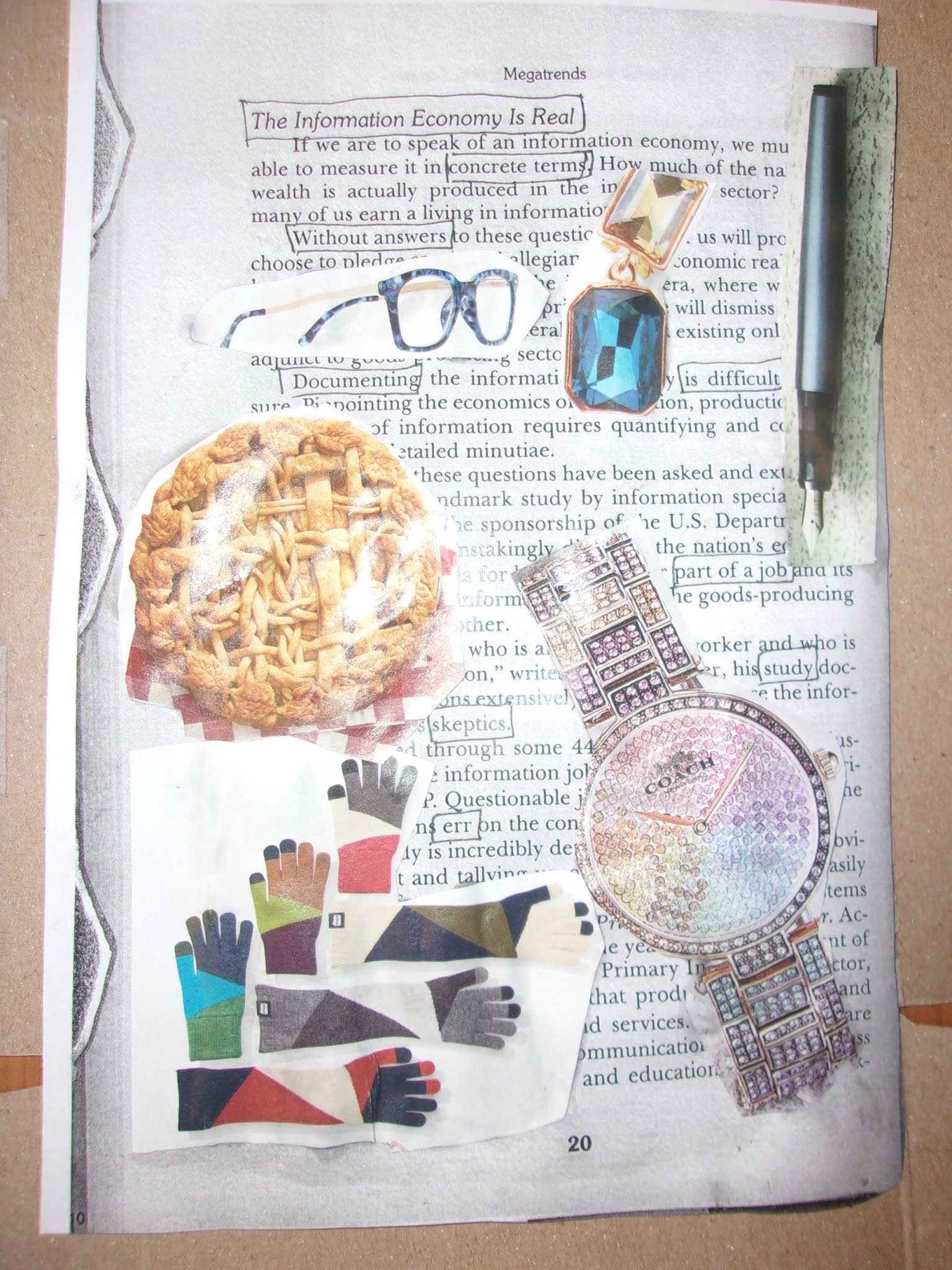
I decided to look for a cheap copy of Frankenstein, which led me down another rabbit hole.  It would probably be easier to use the copy machine, the way I did for an earlier project, where I used the book Megatrends (for more on that process, see this blog post).


Here is the poem alone, before blacking out passages:


Here is the poem with blacked out passages


I woke up thinking about Frankenstein, about ways I might teach my British Lit class even if I'm off campus for some of the teaching days.  I woke up thinking about online discussion posts, but now I'm thinking about a collage/erasure poem.  Now I'm thinking about a wide range of projects that could use erasure and collage.  It's an interesting way of thinking about assessment:  choose a page, make an erasure poem, add collage elements, and write analysis showing how your creation shows understanding of the work.

I spent much of yesterday grading, and much of the grading was English 102 final exams, which had students write about what went well, what could be improved, and one suggestion.  I was surprised by how many people loved the quilting bee that I created (more information in this blog post).  Even counting for the possibility/probability that some of them included this thinking that's what I wanted to hear, the enthusiasm seemed genuine, and it was an enthusiasm that I didn't always perceive on the day of the event.  Many of them said they wished they could have more hands-on ways of learning that way, less lecturing/discussing.

I also wonder if I could have them act out a scene, in lieu of writing about a piece of literature.  I keep thinking about last week's experiment with the final exam being more oral than written, and I wonder if I could create more opportunities like that.  I'm always on the lookout for assessment that's more genuine, more creative, and less able to be done completely by AI.  

I hadn't thought about collage/erasure poems as a way of doing that.  Let me tuck it away for next year.  As of right now, my grades are turned in, and my teaching work for Spartanburg Methodist College is done.


Wednesday, April 16, 2025

Poetry Creation Week in Intro to Lit Courses

This week in my Intro to Lit classes on Monday and Wednesday, we're having a poetry creating week.  On Monday, we experimented with haiku-like creations.  First I tried to have them create a haiku with no inspiration beyond the instruction to create 3 lines in the 5 syllable, 7 syllable, 5 syllable model.  Then we looked at photohaiku (I particularly like the ones at Dave Bonta's Woodrat Photohaiku website).  I brought in 12 photos of my own, printed on regular white paper, and had the students work in groups to create their own photohaiku.  

In the interest of transparency, I'll say that some of them were wonderful and some were, shall we say, not profound.  Some students entered into the exercise fully, while others didn't add as much to their groups.

I told my students that one of the reasons that I scheduled this poetry week when I did was that it didn't require lots of prep work.  Yesterday I laughed, as I was cutting individual lines from my abandoned lines document.  Today, I'll hand every student 4- 6 strips of paper, each with a different line on it, and have them add lines to it.  I have a poetry mad libs kind of assignment to help them generate lines to go with my abandoned lines.  Then we'll tape them all together to see what we get.

It took me 45 minutes yesterday, and I didn't get all the cutting done.  I also rounded up tape dispensers, and today, I'll get to class early so that I can get the tables arranged.

Even though it requires more prep work than I remembered, I'm still glad we'll be doing this today.  As I cut up abandoned lines into slips of paper, I was surprised by some of them--did I really write these?  Yes I did!

I plan to play with those abandoned lines too.  I'm always surprised by the places that these abandoned lines take us.

Here are a few for you to play with too:

Sprout a pair of angel wings from your sturdy spine

This is not the angel song I strained to hear.

Well seasoned skillet and other seductions

Formless prayer beads on a tarnished chain

Overlooked nursery, needled forest floor.

The floors whisper to me of their secrets

Monday, December 30, 2024

Remembering Jimmy Carter

Jimmy Carter died yesterday, and far greater minds than mine will weigh in.  I was 11 years old when Carter was sworn in as president; I was roughly the same age as Amy Carter.  I was a kid who was interested in politics, so I paid attention to all sorts of news stories.  But of course, I was a kid, so I didn't understand everything I read or heard.  Throughout Carter's presidency, I head a lot of adults who were upset with Carter, the man, the president, and all the policies.

I am old enough to remember when people hated Carter, especially as he was leaving the White House and for a decade or two afterward.  By now, many of us know the good work that he did post presidency.  If you want an article that explains why Jimmy Carter was not a failure of a president, as you may have been taught, this one in The Washington Post by Stuart Eizenstat does a good job.  You should be able to read for free:  https://wapo.st/4gwS2JW

And again, I realize that many people, especially younger folks, are aware of the good work he did after his presidency--and so much good work, in human rights, in global health, in helping to protect natural resources, in building houses for those who had none, in continuing to be part of the community, on and on the list could go.  I was always astounded at reports of how he continued to teach a Sunday School class, for example.  I am grateful for how he showed us such variety in ways to live a life faithful to one's core values.

My favorite article of the morning reading, the most comprehensive assessment, an article in The Atlantic by James Fallows, has this quote, and I'll leave the spacing intact:  "Whatever his role, whatever the outside assessment of him, whether luck was running with him or against, Carter was the same. He was self-controlled and disciplined. He liked mordant, edgy humor. He was enormously intelligent—and aware of it—politically crafty, and deeply spiritual. And he was intelligent, crafty, and spiritual enough to recognize inevitable trade-offs between his ambitions and his ideals. People who knew him at one stage of his life would recognize him at another.

Jimmy Carter didn’t change. Luck and circumstances did."

Here's a great closing quote that I found in Heather Cox Richardson's post:  "President Carter said, 'When I was in the White House, I thought of human rights primarily in terms of political rights, such as rights to free speech and freedom from torture or unjust imprisonment. As I traveled around the world since I was president, I learned there was no way to separate the crucial rights to live in peace, to have adequate food and health care, and to have a voice in choosing one’s political leaders. These human needs and rights are inextricably linked.'"

As so many others have said, we were lucky to have a man like Jimmy Carter.  May we all find inspiration as we try to figure out way to live according to our values.

Monday, September 2, 2024

New Moon on Monday, Which Is Also Labor Day

It is Monday, a Monday with a new moon, which sent me to YouTube, where I watched the video for Duran Duran's "New Moon on Monday."  I had never seen this video, which isn't surprising.  I was in undergraduate school, and the communal TV in the lounge barely got network stations; it did not have cable.

The video is oddly compelling, a little film with soldiers that could be East German or Soviet, violence going on in the background, espionage in the foreground, a horse-drawn wagon of explosives in an inner city of cobblestoned streets, a motorcycle speeding across countryside.  It feels like a cultural artifact from a different age, which of course, it is.

It is Labor Day Monday, which feels like a treat.  I'm happy not to be racing through my Monday schedule, which would have me heading down the mountain to Spartanburg Methodist College to teach my 9 a.m. Composition class and then doing my hour at the Writing Center before an office hour and then two more classes.

It is September 2, which means our new health insurance through my job has gone into effect--which means I need to cancel our insurance that I got through the Affordable Care Act.  It means filling out paperwork, which means I need to budget a bit more time than I had thought.  Happily, I will have time later.  Let me get some seminary work done first.

At some point, I will switch to listening/watching the videos I need to for seminary classes this week, but this morning, I am listening to Jennifer Egan's interview with the New York Times podcast show about books.  She's talking in great detail about how she composed A Visit to the Goon Squad.  If I ever teach a creative writing class about fiction and/or short stories, I want to remember this podcast.  She gives great insight about how she arranged the short stories, about the different types of narration (first person, second person, that intriguing experiment with PowerPoint), about the other writing she's done.

It also reminds me of how I wanted to create a book of linked short stories, and I did.  It's not nearly as masterful as Egan's.  It also makes me want to write more fiction, but that's not the semester I can have this term.  If I'm lucky, I can do some poetry writing.

In past years, I would have had a massive poetry mailing created the old-fashioned way, with paper, stamps, and envelopes.  That tells you how long ago it was.  Part of me wants to do a bit of submitting today, but let me not get distracted.  I have seminary work to do.

Thursday, December 21, 2023

Tasks on the Shortest Day: Grocery Stores, Sermon Writing, and Wonder

It's another day where my morning has gotten a bit ahead of me--but for good reasons!  I'm in the middle of rethinking my Christmas Eve sermon.  Let me capture a few details here.

--Yesterday, I went for a walk with a pastor friend and mentor who lives in the neighborhood.  She told me about some ideas that her pastor son presented to the University of South Carolina students, where he is campus pastor.  The Greek word for inn is actually much closer to guest room.  If we say there was no room for Mary and Joseph in the guest room, does it change our understanding of the Nativity story in the second chapter of Luke?  I'm going to write a sermon suggesting that it does, and I'll post it next week.

--It's the Winter Solstice.  From here, we have more light each day:  small dribbles at first, but then more and more.  By the end of January, I expect to be surprised by the amount of light each day contains.

--Today is also the feast day of Saint Thomas.  I wrote a blog post about the juxtaposition of this feast day with the Winter Solstice.

--I read this article in The Washington Post about trees and what their rings tell us about the changing climate. I love the term "latewood," a term I hadn't known before today. I started thinking about my own bones, and what they might tell a researcher. I created some lines that might become a poem. Later today, on my neighborhood walk through the church camp Lutheridge, I will look at trees differently, with a new sense of wonder.

--I made this recipe for salmon rillettes in the way that Dorie Greenspan showed us how to do.  Yesterday I was at the grocery store, and the herbs looked fresh, and they had scallions and shallots.  Smoked salmon was on sale, so I took it as a sign.  It is so good.  Why do I only make it around the holidays?  It's probably healthier than the cheese and crackers I often eat for supper/evening snack.  I am hereby resolving to make it more often.

--Sadly, my dumplings yesterday did not turn out as delicious as the last time they made them.  Not horrible, just not as good as in November.  Hmm.  I did look up the online recipe to make sure that I had the measurements correct.  Hmmm.

--I strung colored lights across the window of the bedroom where my writing desk currently resides.  They delight me.  After Epiphany, perhaps I'll string the white lights up, if I can find them.

--Let me get to the grocery store one more time--and maybe plan ahead for Christmas Day.  


Thursday, December 14, 2023

Advent Treats of the Reading Variety

I am trying to convince myself that I have enough time to write a blog post.  My Systematic Theology paper is due today, at 11:59 p.m.  I have been hard at work, and I am in the writing stage where I don't know if any of it makes any sense.  I have one more section to write, about what salvation means, and that's the part that will be easiest.  The part on Trinitarian theology requires me to weave together many ideas that show I've done the readings and understand the history.  Part of me worries that I'm relying too much on notes and the theology of others.  But that's what the assignment requires; I'm not asked to create my own theology of the Trinity.

I've been enjoying an Advent reading, Gail Godwin's Evensong.  I read it when it first came out, back in 1999, and then I reread it again a few years later.  So, it's been about 20 years since I've read it, and I don't remember much about it.  


It's about a woman who is an Episcopal priest; it's the sequel to Father Melancholy's Daughter, a book I loved deeply.  Twenty years ago, I loved Evensong because it told me what happened to the main character of Father Melancholy's Daughter.  This year, I'm loving it because it's set during Advent and because it's about church life in a mountain town similar to the one where I live and the one where I serve as Synod Appointed Minister.

This morning, I'm enjoying the Fresh Air interview with poet Christian Wiman--lots of great thoughts on faith, pain, and creativity.  Here's a quote to give a taste:  "I think you can believe in God and not have faith. I think faith means living toward God in some way, and it's what you do in your life and how you live it. I don't feel the sense of mystery or terror alleviated by faith. I don't feel that at all. I don't understand when people present God as an answer to the predicament of existence. That's not the way I experience it at all. I have this hunger in me that is endless, and I think everyone probably has it. Maybe they find different ways of dealing with it, whether it's booze or excessive exercise or excessive art or whatever. I tried to answer it with poetry for years and hit a wall with that. And finally ... I discovered ... the only solution to me was to live toward God without an answer."

Well, speaking of quotes, let me get back to that paper for Systematics.

Wednesday, November 1, 2023

Dearly Departed

It is incredibly windy today; my county is under a burn ban until the end of the week, because the fire marshal expects dry, windy conditions to continue.  This dark windiness feels appropriate to this time of year, as Halloween shifts to All Saints, as the warmth of October gives way to a leafless November.  

It's a time when death is on the brain, even if no celebrity has died.  I've been reading the articles following the death of Matthew Perry, who played Chandler Bing on Friends.  In some ways, it wasn't a surprise--he's had intense struggles with addiction for decades, and while so many had hoped he had beaten his demons, even if he had, it's tough on the body.  Still, he was very young, 54.

One of the better pieces I've read was written by Patti Davis, an op-ed in the New York Times, about Perry's addiction and her own experiences.  Here's a nugget:   "I want to tell you something about addiction: No matter who it is or what substance that person is hooked on, loneliness is at its root. For whatever reason — and I have no theory as to why — there are those of us who feel isolated in this world, as if everyone else had some secret formula for getting along, for fitting in, and no one ever let us in on it. That loneliness resides deep inside us, at our core, and no matter how many people try to help us, no matter how many friends reach out, support us, show up for us, it never entirely goes away. It’s vast and shadowy and also part of who we are. Something happens when we discover a drug or alcohol: Suddenly we have a companion holding our hand, propping us up, making us feel we fit in, we can be part of the club. It’s there for us in the empty hours when it seems no one else is."

This morning, I was up even earlier than usual.  I was having odd dreams, fights about drywall in my dreams.  I had that residual restlessness from bad dreams, so I just got up.  I read an e-mail from the dean of my seminary about recent outbreaks of both antisemitic and anti-Palestinian graffiti at American University next door.  I felt weepy, both at the hate that comes in all varieties and at my dean taking the time to write to us all with words of hope in a time of deep distress.  

Her e-mail/letter ended this way:  "Friends, your calling matters. Working toward shalom is working toward a world where everyone enjoys the blessings of abundant life that God intended for all God’s creation, a place where everyone thrives. There are many ways to support peace efforts, to love our neighbors, to lament, to care for the vulnerable, and to pray unceasingly. If you are at a loss for words, pray anyway. Remember that the Spirit intercedes for us when we do not know what to pray (see Romans 8:26-27). Our chapel remains open for prayer. To echo Martin Luther King, Jr., there are many ways to let the light of God’s love shine into the darkness. Let's stand together for shalom."

I lit a candle and watched both the wind beyond the glass, and the little flame that didn't realize all the forces that would snuff it out if given much of a chance.  I thought of how autumn has shifted to a time of dry, dead leaves and immense amounts of pine straw. 

I said a prayer, for mercy on all our souls, the living and the dead.


Tuesday, October 17, 2023

Baking Biscuits While the World Burns

Yesterday I made this Facebook post:  "So, the world is breaking into bits, but I feel compelled to note that I have made the best batch of biscuits ever, and I've been baking biscuits since I was 9 years old. Usually my biscuits are closer to hockey pucks, but not this time. I achieved both height and flakiness. Was it the extra tablespoons of butter in the recipe? It's easily double the amount of butter I usually use. Was it the use of the pastry cutter and not the food processor? The fact that the recipe uses both baking soda and baking powder? Can I replicate this experience again? Stay tuned! In the meantime, here's a link to the recipe, in case you want to run your own experiment (the pictures are from the website--we ate all the biscuits I made before I thought to take a picture)."

Part of me wonders why I'm writing about biscuits instead of the Israel/Gaza situation.  But I started baking biscuits shortly after the Yom Kippur war in 1973, which some commentators say was the last time Israel had such a disastrous failure of intelligence and security.  Through all sorts of crises, I've turned to baking, sometimes biscuits, sometimes homemade bread, often cakes and cookies.

Of course, I would likely have been doing that baking had there been no geopolitical crisis.  I don't have much to say in terms of writing further about the situation in Israel, not much more than I said in last week's blog post.  So, yes, let me write about biscuits.

I first started making biscuits in childhood, but I can't remember exactly why.  Because of my voracious reading, I was interested in making the foods I read about, so that's probably what led me to biscuits.  My mom found a recipe in Helen Corbitt Cooks for Company, one of her favorite cookbooks, and I was off.

That cookbook is long gone, so I can't compare that recipe to the one I used on Sunday.  I know that through the years, as I've been worried about my weight and our intake of saturated fat, I've tried to make cookies with reduced amounts of butter.  On Sunday, I followed the recipe on the Smitten Kitchen site without making any changes, so I used nine tablespoons of butter.

When I first started making biscuits long ago, I used two knives to cut in the butter, a laborious chore.  I was thrilled to discover the food processor made short work of the job, although I didn't really use one until the 1980's.  But after Sunday's experience, I wonder if the food processor made the butter too fine.

On Sunday, I used a pastry cutter.  I've always wanted one, and in September, a dear friend gave me I a gift basket with one.  I decided to give it a try on Sunday, and it did the perfect job of mixing the butter chunks with the flour.  I'll be using it again, for biscuits and pie crust.

I had stopped making both biscuits and pie crust because my efforts came out too tough.  For pie crust, I thought that the ready-made, roll into your pan crusts worked fine, and certainly better than my own efforts.  For biscuits, I haven't used any of the ready to bake offerings--they all taste of chemicals to me.

Maybe I'll return to pie crusts.  I have a lot of apples.  I see an apple pie in our near future.

Thursday, April 6, 2023

Maundy Thursday: Back to the Table

Here we are, Maundy Thursday again.  I am in a house that I didn't own last year.  Last year, Maundy Thursday was the day before I broke my wrist.  This year, I am hearing all the broken body parts of our liturgy differently.

Diana Butler Bass has already written the perfect Maundy Thursday essay, the type of essay where I almost decide I don't need to bother to write anything further.  She writes "Christians mostly think of Maundy Thursday as the run-up to the real show on Friday."  And then she writes a whole essay to address this idea:  "What if we’ve gotten the week’s emphasis wrong?"  She writes a whole essay to expand on the idea that the table, the meal, should be the main point, not the cross.

On this day, I'm thinking of Anselm and his ideas of atonement.  On this day, I'm wondering what would have happened if Christianity had emphasized something different, if the cross could have been a different kind of symbol.  More on that tomorrow.

On this day, I'm thinking of those earliest Christians, sharing all they had, not calling themselves Christians yet, just a group of people who had experienced something shattering.  They gathered to try to understand what had happened and how to move forward.  They expected Christ to come again soon, in their lifetimes.  Reading Paul in that context changes some of his letters for me.  I still wonder if we would be better off without them.

I still wonder what letters are lost to us, letters from other earliest followers of the new way.  I am dreaming of a recipe book from those earliest Christians, a book of recipes and stories about new life.

This week, with its mix of Spring holidays, including Ramadan and Passover this year, along with all the Christian holidays, also reminds me of a poem I wrote long ago now, while all these images swirled in my brain and my quilt group met. We wouldn't have had the meal that the poem describes, but everything else is factual. Well, I wasn't exactly the lapsed Lutheran in the sense that I once was, but like the rest of the poem, it's true, if not factual.

It was first published in Ruminate.


Eucharist


I knead the bread leavened with beer,
stew a lamb shank in a pot of lentils,
prepare a salad of apples, walnuts, and raisins,
sweetened with wine and honey.
No one ever had herbs as bitter as this late season lettuce.

My friends gather at dusk, a motley band
of ragtags, fleeing from the Philistines of academia:
a Marxist, a Hindu, a Wiccan, a Charismatic Catholic,
and me, a lapsed Lutheran longing for liturgy.

Later, having drunk several bottles of wine
with prices that could have paid our grad
school rents, we eat desserts from disparate
cultures and tell our daughters tales from our deviant days.
We agree to meet again.

Gnarled vegetables coaxed from their dark hiding places
transform into a hearty broth.
Fire transubstantiates flour and water into life giving loaves.
Outcasts scavenged from the margins of education
share a meal and memories and begin to mold
a new family, a different covenant.

Monday, January 16, 2023

"Evil Is Not the Totality of Who We Are as Persons"

Yesterday, we watched one of the Sunday political shows on TV before we headed to church.  I stitched a bit while listening to people argue over each other on TV.  I thought about how different this TV medium is from my usual news delivery source, NPR, sometimes on the radio, sometimes by way of internet.

My thoughts also turned to Martin Luther King, who was born on January 15, yesterday his true birthday.  I wrote a blog post about it yesterday morning, so it was on my mind.  I thought about how unlikely it was that he would get a federal holiday dedicated to him, such a short time after his death.  I marveled at the fact that I was alive when it happened, and how much further away we are from his death.  Now he has a monument in the heart of the nation's capital, so for many people growing up today, he seems like a mythic figure, not someone who walked the earth not very long ago.

Today I am listening to this episode of The Ezra Klein Show, a deep dive into King's thoughts with Brandon Terry.  For me, it's a great way of celebrating this holiday.  I am visiting my parents, so it doesn't feel safe (in terms of respiratory disease) to gather in large groups, working close together to do works of social justice.  It will be too cold to go to a parade.

It's interesting to think about King's trajectory.  In his lifetime, he did substantial work to reshape the nation into one that is more just.  Most of us will admit that there is still work to do.  When I was young, before there was a national holiday, we read his work in school.  Granted, it was often the work that was shorter and easier to understand.  Now we read his work in one or two sentence memes that circulate on social media.

Maybe it's better than not hearing these ideas at all.  But his work was so much deeper, and as I look around me, it's clear that most people have not done this level of deep thinking about the risks of violence, the benefits of non-violence, the best way to live a life in an empire that doesn't care if you die and in fact, may prefer you dead to alive.

I feel like we once did more of that, both as individuals and as a society, but perhaps it seemed that way to me because I was a college student, where more of us were wrestling with these questions.  In an ideal world, I'd be able to find this kind of questioning community in a church, but that's not always the case.

I am listening to this podcast (the one I mentioned above), which mentions his darker days, the ones where some of his allies abandoned him for his stance on the Vietnam War, where he was drinking more.  I imagine that many of us don't know this side of King, and I wonder if we might have more forgiveness of ourselves, along with more strength to persevere, if we knew of this.  King's trajectory is often taught as if his wins were a sure thing, much the way that those signers of the Declaration of Independence were sure to win.  But those wins were very much not a sure thing.  It's astonishing that anyone who has fought for a more just world has had any win at all--the forces of empire are very strong, and they are not forces easily bent to justice.

I am grateful that we have this holiday, even if its one that is easily manipulated in ways that King would not appreciate, in ways that many of us wish would be different.  It is good to be reminded that  those of us working to bend the arc of the moral universe to justice may not see the work done in our lifetimes--indeed, almost certainly, we will die, and there will still be work to be done.  It is good to be reminded "that evil is not the totality of who we are as persons" (Brandon Terry's words)--or as a society.

Tuesday, October 25, 2022

October Hinge

I had a night of mixed sleep and woke up with the taste of the latest anxiety dream still in my mouth:  I needed to go to a different city to finish an internship for my spiritual direction certificate program, even though in my dream (and in waking life), I had the actual piece of paper with my certification.  As the dream ended and I woke up, I faced the rear view window, bidding farewell to DC in the sunset light, vowing to return.

I understand how my subconscious mixed the elements of waking life--I had been at a late afternoon Zoom session about changes to the internship requirement of my current MDiv program.

My brain has been thinking about various cities, especially in the light of Church History I class.  Every time we discuss an event in Carthage, I think "to Carthage then I came," and I marvel at how T. S. Eliot is woven into my brain.  Part of me wants to reread "The Waste Land" and part of me wants to read the part of St. Augustine that inspired T. S. Eliot, and part of me feels I have given enough headspace to male voices talking about cities.

This morning I read "End Times," an amazing poem by Dave Bonta, and I am grateful I haven't given up on all male voices.  He so perfectly describes what I've been trying to capture about these last moments in autumn, when some of the trees are still glorious in their color, but you can see the transformation coming.  Here's how it ends, and the poem earns this ending (as my old lit professors would say):

"i sit watching
the treetops glow

in sun that they can
no longer taste"

My thoughts turn, as they often do, to autumns past.  Having just returned from a trip to see my parents, I'm thinking of October of 1983, the first time I left to go back to my family home.  Early in the month, my mom appeared at my dorm room door, as planned, to pick me up and take me back to surprise my dad for his birthday.  At the end of the month, I went home again, and did a bit of shopping.  I bought a copy of U2's War, which I played non-stop as autumn shifted into winter, as the Soviet Union shifted and bombs exploded in Beirut and soon we would watch The Day After and think about apocalypses on a major scale.

When I look back on this autumn, how will I frame it?  Here are some possibilities:

--It was the first autumn in decades where I got to see the slow shift of the trees, as opposed to breezing in for a week-end.

--I was learning about parts of history that had eluded my previous learning, both in Church History I class and by the Timothy Snyder lectures on the making of modern Ukraine that he taught at Yale (so lucky to be getting them in close to real time).

--A different Russian/Soviet leader blusters about nuclear war, and once again, we're talking about a meeting place when the unthinkable happens.  I'm thinking about the scene early in The Day After, as Soviet forces amass on the border between the two Germanys and the Jason Robards character comforts his wife by saying "They might be crazy, but they're not that crazy." 

--I got back into a daily practice of sketching.  What did I sketch?  Autumnal trees, of course.

--I took lots of walks to drink in the autumnal loveliness.

--I thought about various mental states, how they can coexist in one brain.  I'm both happy to be here and missing other places, happy in my solitude and longing for loved ones.

--I am sure I will look back on this autumn as a hinge season, between the old me and the new me, between the world we are leaving behind and the one we're traveling toward.  But isn't every season such a hinge?

Saturday, September 3, 2022

Farewells: Fear of Falling, Failing

There are some weeks where no one dies.  Then there are the weeks where I feel like I should note significant passings.  Happily, so far, no one I know personally has died.  

I was working on seminary studies earlier this week when the news broke of Mikhail Gorbachev's death.  I thought about how young he was, and then I thought, no, wait, he was young decades ago.  I was a bit stunned to read that he was in his 90's.  I remember when he came to power after a string of elderly Soviet leaders died one after another during my undergraduate days.  I thought about how he might be in power for much of the rest of my lifetime, like Stalin.  As the months and years went on, I wasn't sure how to process his approach to governing.

Me and lots of other people and maybe Gorbachev himself.  In the days that followed his death, many people wrote about him, but my favorite is this article by Anne Applebaum, which includes this gem:  "Almost nobody in history has ever had such a profound impact on his era, while at the same time understanding so little about it."

Barbara Ehrenreich, on the other hand, had a vast knowledge of  the history of our time, and her writing helped us understand it too.  I became aware of her work in the mid 80's when I read the 1970's writing that she did with Deirdre English on the subject of the history of women's health.  When I was in grad school, I got a used copy of Fear of Falling: The Inner Life of the Middle Class.  I thought that the insights that she had about women's fear of poverty was also applicable to grad students.

Of course it was her work that became Nickel and Dimed: On (Not) Getting By In America that gained her a larger audience.  I remember reading an earlier version that was a magazine article in Harper's.  I read in a college library where I waited to interview for an adjunct position that I didn't get.  I remember thinking about how many low wage jobs existed that I knew very little about--happily, Ehrenreich was there to show us the way.

I was lucky enough to get to see her in 2009 when she came to Books and Books.  I wrote this blog post about it.  She was charming and gracious and so, so funny.

I think about her work and how I once thought that her undercover work as a low wage worker might lead to lasting social change for those on the lower rungs.  So far, it has not.  I think about Gorbachev and how the fall of the Soviet Union both led to more freedom for many nations, but also to Putin's reactions to his feelings of shame/distress/anger at how his nation fell.  I am thinking of unintended consequences and the work still left to be done.