Sunday, April 7, 2019

Passiontide and the Violence of April

In a long ago season, this Sunday, the last Sunday in Lent, two weeks before Easter, we'd have begun a time called Passiontide.  I first learned about this concept in Gail Godwin's wonderful book Father Melancholy's Daughter.  I'd quote from it, but that book is in a box in the cottage.  Some days I despair of ever seeing it again.

We live in a time of compression, not stretching out.  This morning, I'm back to my thinkings about silence and about how we try to cram too many things into a Sunday. Today, the cramming will be partly my fault.  After church, we go to Lowe's to get more supplies for house restoration, and then my brother-in-law will come to help us move some heavier furniture.

This morning, I'm wondering if how our experience of Holy Week might change if we stretched it out, rather than trying to contain it all into one Sunday morning. Two weeks to spend with one of the central events of our faith: how might we change?

I'm also thinking of all the ways that April can be a violent month.  This year, two of the world's major religions, Christianity and Judaism, celebrate events central to their faith, Easter and Passover, events rooted in violence.

April is a month of all sorts of grim anniversaries: the Oklahoma City bombing, numerous school shootings (most notably Columbine and Virginia Tech), the anniversary of King's assassination.  Today marks the 25th anniversary of the Rwandan genocide.

The weather in April can be violent too, as seasons compete for dominance.  April is a time of tornadoes.  I had all these images swirling in my brain when I wrote the following poem:


The Ides of April


Mid April, when bills come due and debts
must be paid. Both winter and summer battle
for dominance and rip the landscape
with tornadoes and late spring snows.

Good battles evil, captives set free
by way of forced and bloody frenzies. Refugees
driven from their homes trudge down dusty
roads towards a desert destiny of freedom.

A gospel of radical love battles entrenched
orthodoxy. We must sacrifice our lust
for structure and rules, our yearning
for punishment. We must arc our minds
towards grace and unconquered redemption.

We must be as flowers who battle
against the frozen ground, who thrust
themselves towards a distant sun
in the hope of a future warmth,
a profuse explosion of fiery blooms.

Saturday, April 6, 2019

Hurricane Recovery and the Trip to the Lan Su Chinese Garden

Yesterday we got the good news:  our countertops will be installed on Monday.  Hoorah!

That meant we needed to jump into action.  Because our countertop is Corian with a seamless Corian sink, we need a faucet.  So off we went to Home Depot yesterday.

The good news:  we did find a faucet.  The bad news:  Home Depot is more difficult to navigate than ever.  And they only had one ugly chaise lounge cushion.

So we came home and made an online order.  We are also continuing our quest for curtains.  Once I enjoyed all of this choosing of new stuff more than I am enjoying it these days.  I am just ready to be done with this remodel.

Today I will spend time getting the front room ready for my sister's arrival the Thursday before Easter.  Tomorrow, my brother-in-law will come to help us move some heavier furniture, including the guest room bed.

I am also thinking back to last week-end, to our trip to Lan Su Chinese Garden.  Let me post some of the photos that I didn't have a chance to post last week:


I loved the beauty of the garden.


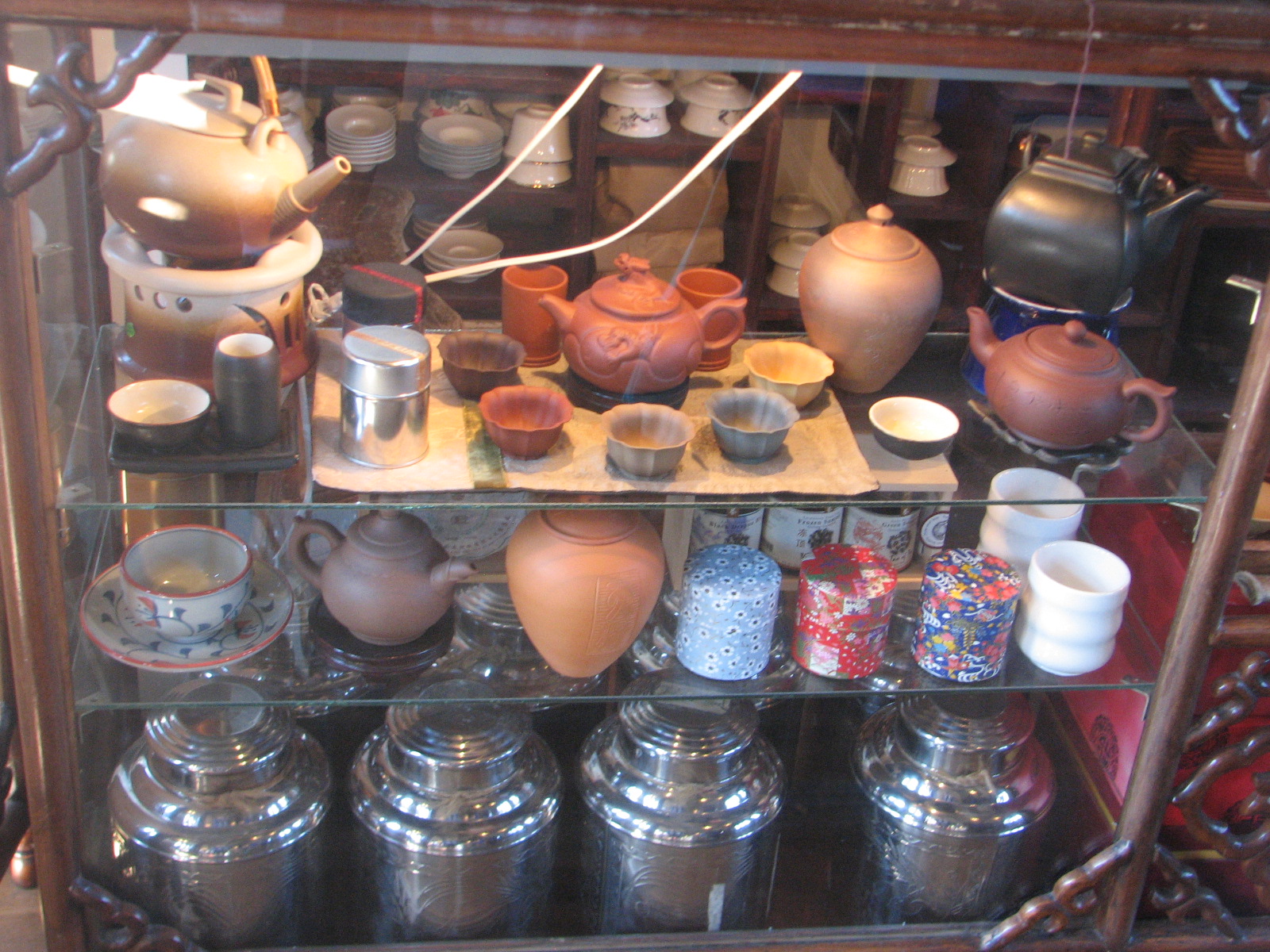
But I really loved the tea room.


We had interesting treats, like a tea steeped egg


that came in this eggshell:


I loved all the tea pots. 


And the tea was both soothing and robust:


And now I am fortified to face the work of today!


Friday, April 5, 2019

Of Smart Phones and Cameras

If ever I get a smart phone, it will not be because I need to be able to make a phone call at any time or any place.  It will not be so that I can watch streaming material on a tiny screen.  I won't want to text or read my e-mails.

No, if I get a smart phone, it will be for the camera. In fact, I wonder if there's a way to get that camera without all the other technology attached.  I've done a bit of research, but if it's out there, I haven't been able to find it.

I have what once would have been a fairly expensive camera, at least for my budget.  But I can't figure out how to make it take the same quality of picture.  And it's big and heavy.  I envy the folks who have a camera that fits in a pocket.  It needs to be a large pocket, but I'll never have a pocket big enough for my fancy camera.

Last week I made my way to the AWP bookfair to meet the writer Jeannine Hall Gailey in real life.  We've been communicating online for years--we think it's at least 10 years.  We're Facebook friends and blogging friends and we've even sent each other long e-mail exchanges.  In short, there's a depth to our friendship that I don't have with all of the poet/writer friends I've met online.

Her spouse took pictures, both with the smart phone and with my camera.  My picture prompted a response that I usually have:  despair and the thought of teeth whitening, hair lightening, more sleep.  Here's the picture with my camera:


Later, Jeannine posted the picture from the phone.  It's taken a minute before the one above.  Same lighting, same people, same time, same location, but what a difference:


I know that people who post on Instagram have a variety of filters to make their pictures look beautiful.  But having a better quality picture to work with must help too.  I must remember this as I'm looking at the pictures of others.

Later, on Saturday, my grad school friend and I went to the Chinese gardens--it's a beautiful oasis in the middle of Portland.  Sure enough, we just happened to see Jeannine there.  Again, her spouse took a picture, which she posted later:


We chatted for a few seconds and then went our separate ways.

I've had a lot of serendipitous running into people at AWP, but this one may be the all-time winner, just happening to see each other at an off-site attraction, one as beautiful as the garden.

Thursday, April 4, 2019

Intersections of Poetry and Visual Art

A week ago, I'd be waking up in Portland, eating a hearty breakfast, getting ready to figure out the mass transit system to make my way to the Convention Center.  As I think back over all the AWP sessions I attended, the one that made me want to ditch the rest of the conference to approach my writing in a new way was the one on Intersections of Poetry and Visual Art at 10:30 on Thursday.

My brain had already been thinking about this possibility (see this blog post from December, for example).   I had even been wondering if this character, which seemed to be emerging over multiple sketches, might be a book-length exploration of something:


The above is from December, and the below is from January:


I hadn't returned to these ideas, in the terms of this female figure and ideas about her.  But the AWP session made me think that it might be interesting to see these sketches with words as individual poems that could make an interesting collection.

It made me want to return to some poems and see if parts of them might make good sketching prompts.  I was interested in the process of the poets at the AWP session.  As you might expect, they approached the intersection of visual art and poetry from a variety of angles:  some of the poets and artists worked in true collaboration, in some the words came first and then images, and then one woman worked more as a collage artist. 

Naoko Fujimoto read a poem while showing a visual work that incorporated the poem, and it was clear that she didn't use the whole poem:


That, too, made me think about possible approaches with poems I'd already written.


I was interested in this artist's collaging approach:  she uses words, papers, images, cut out shapes, and perhaps some graphic approaches like stamping (hard to tell from the slide):


My grad school friend went to this session too, and we both agreed that we wanted to go back to our hotel and play with our limited art supplies that we'd brought with us.  Instead, we went to a coffee shop to digest (I didn't even mean to make that pun).


I yearn for time to return to my sketchbooks and to create more materials.  I also want to record another thought I've had.  I've been doing some photo essay/poem kinds of things--this blog post, for example, seems like a poem in a different form.  I had been thinking of making a book of those, but now I'm wondering about a combination.

I also worry about following this road--are these books so expensive to create that there won't be much market?  Do I even care about markets anymore?

And then around my edges this morning, the despair at having these inspirations and not feeling like I have time and space to explore.  Perhaps at the Create in Me conference that starts in 3 weeks, perhaps then I can have some time and supplies and table space to have this kind of joy!


Wednesday, April 3, 2019

The Obligatory AWP Book Post

Here's my obligatory photo, albeit a bit dark, of the books I got at the AWP, all of them from the bookfair:


I brought a backpack full of library books to AWP, and I thought of not buying any.  The first wandering through the bookfair is so overwhelming that I often flee.  Here's a sketch I made of my first impression of the bookfair:


But the lure of a good deal on the last day of the book fair gets me to return.  I stopped at the Norton table and found great deals in the $5 box:  Molly Peacock and Sandra M. Gilbert.  The Hoagland book was on sale for $10, and I got the collection on women and ambition for $10 too.  I confess it was an impulse buy, triggered in part by my various insecurities that this conference produces.

The 3 books by Lynda Barry were a different kind of impulse buy.  I went to the last panel I would attend, one on using glitter, legos, and other kinds of arts and crafts supplies/approaches to inspire writing.  One of the panelists had studied with Barry, and I was remembering how much I loved her book Syllabus when I checked it out of the library.  The panelist mentioned it was on sale at the bookfair, and one of the audience members mentioned another book that was good.

After the session, in the last hour of the bookfair, I raced back to the publisher's table, and it was still there, along with the other 2.  I said, "Could you make me a deal for all 3?"  I just went to Amazon, and it wasn't such a wonderful deal that I got, but I want to believe that the publisher got more of my money than if I bought through Amazon.

Now I need to actually read them.  I am now surrounded by stacks of books, with boxes of them out in the cottage waiting for some decisions.

But of all the books I read during my journey, the one that stays with me is Rebecca Makkai's The Great Believers.  What a wonder of a book!  The subject matter sounds heavy, and it is, but I loved it.

It was interesting to read that book, see her speak on Thursday, and the next morning going to a panel on Angels in America--interesting to think how the subject of AIDS wove its way through the conference.  And as I think about what most fed my intellect during the week, those 3 events (reading the book, hearing Makkai and Tayari Jones on a panel, and the session on Angels in America) are the ones that did the most.

It was cool to be at a conference that did so much for both my intellect and my creative soul.  More on the creative inspirations tomorrow.

Tuesday, April 2, 2019

The Downside of AWP

I've been writing about the AWP conference in breathless, glowing terms.  Let me write today about some of the downsides of the conference.

When I arrived in Portland, Oregon, I thought about how different this convention center seemed from those in other towns, and as the conference progressed, my opinion just solidified.  The conference center is in a tangle of Interstate highways, and if there were hotels within an easy walking distance, I didn't see them.  We found one place that served food within an easy walk, but it didn't have many places for people to sit, and of course, every seat was taken.

Happily, there was a light rail system, so we were able to get around.  I took it after the Colson Whitehead keynote speech, which meant I took it after 10 p.m., and it was reliable and seemed safe.  I didn't try to master it enough to get to offsite events, but that was more about my energy levels than the system.

I know that the conference needs a huge convention center to be able to offer all the panels that it does.  Some part of me wonders if we might do better with fewer panels.  At the very least, the organizers should make sure that each time chunk has completely different panels, and for the most part, that happens.  There was one time period that contained two panels about a very esoteric topic that sounded similar.  I don't envy conference organizers.

I also didn't envy anyone who had any sort of mobility issue.  The conference center was vast and sprawling and under construction.  Some of the passage ways were very narrow.  I averaged 15,000 steps a day, and I wasn't doing any exercising to boost that amount.

I would also change the way that name badges are distributed.  The lines on the first morning were very long.  Yes, it would be great if we could all arrive the day before to get our materials, but we can't.  Why not send me a one-use code so that I can print my badge at home and bring it with me?  Is the AWP really concerned that I'll print a badge for all my friends?

I have larger concerns.  I think about the cost of the conference--the literal costs and the larger costs.  I think about the travel that most of us did, and the burden the planet bears when we all take planes and cars.  I think about how much the conference costs each attendee.  The cost of the conference itself is very reasonable, but factoring in the hotel, the plane, and the food I needed to buy, my friend and I guessed that the conference cost us each over $1000.  Is that the best use of money?

Some years I say yes, and some years I say no.  I do find it inspiring.  I did return home brimming with ideas.  I do realize that I'm lucky that I have resources.  I don't know how all these students afford this conference--student loans?  Is the conference worth debt?

I also know that I don't make as much use of the conference as I could.  I could go to every table in the bookfair to make connections or at the very least, to see how books look in real life--are they worth the price of submission?  But I don't.

I'm not even very good at making advance plans to meet people I'd like to meet, old friends and blogging friends and Facebook friends.  It's not like a smaller retreat where there's a real chance for connection.  I can't figure out very far in advance where I'll be, in terms of sessions offered.

All of this being said, I'm planning to go to next year's AWP in San Antonio.  I've always wanted to go to San Antonio, and a conference gives me a good reason.  Perhaps I'll go a day early to see more of the town.  Perhaps I'll take a day off on the other end to recover.  It will be held in early March, which is better for me than late March.  I couldn't take yesterday off because it was the beginning of the term.

I'm looking forward to having some time tonight to continue to process all of this--or to unpack.

Monday, April 1, 2019

Be Your Best Teacher, Not Your Ideal Teacher

At some point, I may go through my AWP notes in hopes of capturing those things which seem worth remembering.  I go back through my blog more often than I go through my travel notebooks, because it's more searchable.  I suppose I could have lugged my laptop everywhere, but it's much easier for me to take notes by hand.

Part of me wonders why I'm taking these notes.  In part, it's a way of paying attention.  In part, because those things I note seem worth it at the time.  I looked through the notes I took at last year's AWP, and I enjoyed the memories as I read through them, but didn't find much of the material speaking to me a year later.  Hmm.

I talked about blogging with a fellow conference attendee on the plane ride back.  She gave me several quizzical looks as we chatted while the plane was descending to the Dallas airport.  I said that I didn't realize Portland was such a big city--that quirked eyebrow was deserved.  But when I said I blogged, she said she had kept a blog once, but didn't write anymore.  She said it seemed like such a chore, that daily writing.

I realized as we chatted that I keep this blog for all sorts of reasons.  It's become a repository of all sorts of things, and it's more searchable than my written notebooks.

Today instead of looking back over my notes, let me capture here the one tidbit that was so memorable that I don't need my notebook to remember.  As I've moved through the conference, one person's advice stuck with me.  At a panel about achieving balance between doing one's own writing and helping student writers, one woman said, "Don't be the teacher you always wished you had.  That's a way to insanity.  Instead, think of a good teacher that you had in real life and try to be that person."

It seemed like a great way of capturing the way that many of us set impossible standards for ourselves, and then beat ourselves up for not ever living up to them.  It seems applicable across many of life's situations:  the way we think we should be more spiritually evolved, our relationships with each other, on and on I could go.

Another note about that panel--they were refreshingly honest about how much of the drudgery work they have outsourced, like the cleaning of the house and the lawn work.

Now it's back to that regular life--so much work I haven't yet outsourced and so much of it that can't be outsourced.  I need to go to spin class and then work.

But before that, let me also capture the wonder of the geography of this country as seen from the air.  Yesterday I saw both Mt. Hood and Mt. Saint Helen's.  I gasped when I saw Mt. St. Helen's, that snowy peak stuck on a green landscape, and then later Mt. Hood.

And then we were over the mountains, seeing that vast dry landscape, and then more mountains, which I assume must have been New Mexico.  I thought about how amazing it was that people made their way across that landscape, on horses or in covered wagons.  There's so little water visible from the air.  And the land looks treacherous, even from above--or do I think that, just because I know the history of those settlers?

Interesting to see the mountains and rivers from the air, those places I've read so much about, those places that have shaped my imagination--and the larger country too.

And now, back to more mundane things:  spin class and then work, where a new term awaits.  Welcome Spring quarter!